Ford F-150 Lightning Home Charging: The One EV That Uses 100 Amps
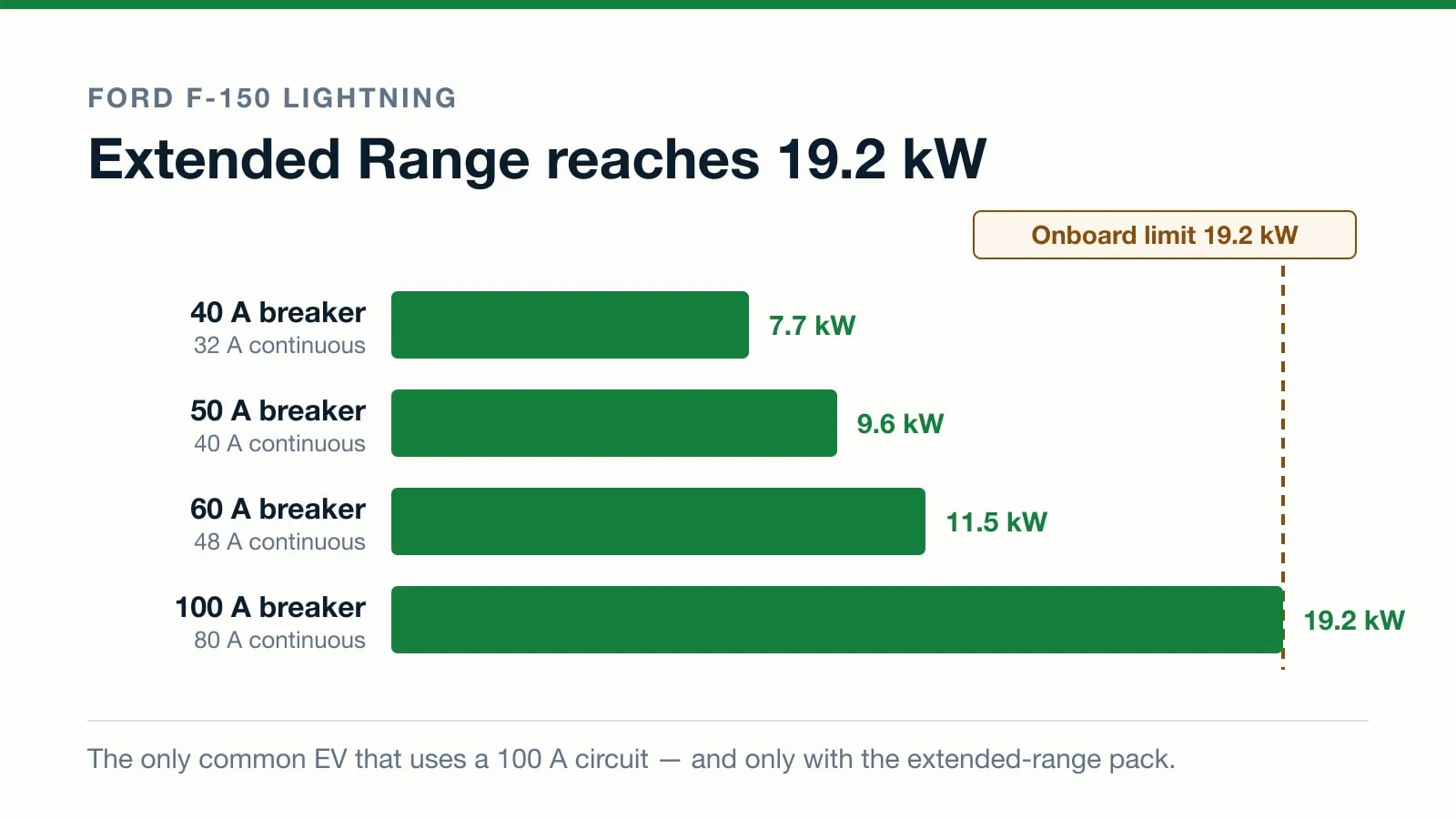
Extended Range trucks reach 19.2 kW on dual onboard chargers — the only common EV that justifies a 100 A circuit. Standard Range stops at 11.3 kW, where 100 A buys nothing.
Every other article in this cluster ends with the same advice: do not pay for a 100 A circuit, because no car will use it.
The Lightning is the exception — for exactly half of the trucks sold.
Two trucks, two completely different installs
The battery pack determines the onboard charging hardware, and the difference is not a trim detail. It changes the electrical work by thousands of dollars.
| Battery | Onboard chargers | AC ceiling | Circuit that reaches it |
|---|---|---|---|
| Extended Range | Two 40 A units | 19.2 kW | 100 A breaker, 80 A continuous |
| Standard Range | One 48 A unit | 11.3 kW | 60 A breaker, 48 A continuous |
An extended-range truck genuinely uses 80 A. It is, as of 2026, the only common passenger EV in North America that does.
A standard-range truck stops at 11.3 kW. Installing a 100 A circuit for one delivers precisely nothing — the second onboard charger it would feed does not exist.
Confirm which pack you have before anyone quotes you. This is the single most expensive thing to get wrong on this vehicle.
What each circuit restores overnight
At roughly 2.0 miles per kWh — trucks are not efficient, and this is a realistic all-season figure rather than a highway best case:
| Circuit | Power | Miles per hour | Added in 10 hours |
|---|---|---|---|
| 40 A | 7.7 kW | ~15 | ~155 |
| 60 A | 11.5 kW | ~23 | ~230 |
| 100 A | 19.2 kW | ~38 | ~385 |
That bottom row is why the Lightning is different. With a 131 kWh extended-range pack, a 60 A circuit takes around thirteen hours to fill it from low. A 100 A circuit does it in eight. On a vehicle this large, the circuit size stops being academic.
The part that actually decides it: your panel
An 80 A continuous load enters the load calculation at 100 A. On a 200 A service, that is half the house’s capacity before the house draws anything at all.
This is where extended-range Lightning installs get expensive, and it is rarely the wire that does it. It is the service.
100 A circuit vs 60 A for an Extended Range truck
Pros
- Fills the 131 kWh pack in about 8 hours instead of 13
- Uses both onboard chargers, so nothing on the truck is idle
- Required anyway if you want the Charge Station Pro at full output
- Genuinely useful on a vehicle whose pack is twice a typical car’s
Cons
- Consumes 100 A of calculated capacity — half a 200 A service
- Frequently triggers a $1,500–$3,500 service upgrade
- Much heavier conductor; a long run gets expensive quickly
- Delivers nothing at all on a Standard Range truck
Before accepting a service upgrade, ask about load management. A device that throttles the truck when the house draws heavily can keep an 80 A circuit inside an existing service, and it costs a few hundred dollars against several thousand. The load calculation article works through when that applies.
The circuit behind the number
Same rule as every other EV, with bigger numbers. Charging is a continuous load, so the breaker is 125% of the current: 80 × 1.25 = 100 A.
Conductor selection at 80 A is where this install stops resembling an ordinary one. The starting point is 3 AWG copper or larger, voltage drop compounds faster at higher current, and a long run to a detached garage can push it to 2 or 1 AWG. That is heavy, expensive cable, and it is the second place these quotes climb.
The Charge Station Pro, and what it is really for
Ford’s Charge Station Pro is an 80 A unit with two extra pins that let the truck send power back over CCS. It ships with extended-range trucks.
Two things worth being clear about:
On a standard-range truck it is not faster. That truck has one 48 A onboard charger, so it draws 11.3 kW from the Pro exactly as it would from any 48 A wall box.
The wall box alone does not power your house. Vehicle-to-home backup requires Ford’s Home Integration System — an inverter and a transfer switch, installed separately, at a cost comparable to a home battery. The Charge Station Pro is one component of that system, not the system.
If backup power is the reason you are buying the truck, price the whole installation before deciding, not just the charger.
The bottom line
Find out which battery you have. It is the fork in the road.
Extended Range: a 100 A circuit is legitimately worth it, and it is the one EV install where 80 A is not overspecification. Budget for the load calculation to come back tight, and ask about load management before accepting a service upgrade.
Standard Range: a 60 A circuit extracts everything the truck can take. Treat it like any other 48 A EV and ignore every 80 A recommendation written for the other truck.
Frequently asked questions
What size circuit does an F-150 Lightning need?
It depends entirely on the battery. Extended Range trucks have dual onboard chargers totalling 19.2 kW and can use a 100 A circuit at 80 A continuous. Standard Range trucks have a single 48 A charger limited to 11.3 kW, and a 60 A circuit extracts all of it.
Does the Charge Station Pro charge a Standard Range truck faster?
No. The Standard Range truck has one 48 A onboard charger, so it draws 11.3 kW from the Charge Station Pro exactly as it would from any 48 A charger. The Pro's value on that truck is bidirectional capability, not speed.
How many amps is 19.2 kW?
80 A at 240 V. Under the 125% continuous-load rule that requires a 100 A breaker and conductors rated for it, which is a substantially larger install than an ordinary EV circuit.
Can a 200 A service handle an 80 A EV circuit?
Sometimes, and it is the question that decides the project. An 80 A continuous load is 100 A of calculated capacity, which is half a 200 A service before the house draws anything. A load calculation is not optional here.
How long does an F-150 Lightning take to charge at home?
An Extended Range truck takes roughly 8 hours from 15% to full on a 100 A circuit, and about 13 hours on a 60 A circuit. The big pack is what makes the circuit size matter more on this vehicle than on any other.
What does the truck need to power my house?
The Charge Station Pro plus Ford's Home Integration System, which includes a transfer switch and inverter. The wall box alone does not provide backup — that is a separate, larger installation.
Sources
- Ford, F-150 Lightning charging frequently asked questions — Ford's own documentation on the 80 A Charge Station Pro and the standard-range truck's single 48 A onboard charger.Accessed 16 August 2026.
- InsideEVs, How to charge the Ford F-150 Lightning — Cross-check on the dual 40 A onboard chargers in the extended-range truck and the 19.2 kW total.Accessed 16 August 2026.