Ford Mustang Mach-E Home Charging: Why 50 Amps Is Usually Enough
The Mach-E's onboard charger tops out at 10.5 kW, which falls between two standard circuits. Here is why a 50 A circuit gets within 0.9 kW of it, and when 60 A is worth the conductor.
The Mach-E is the awkward one in this cluster, and it is awkward in a way that saves you money if you notice it.
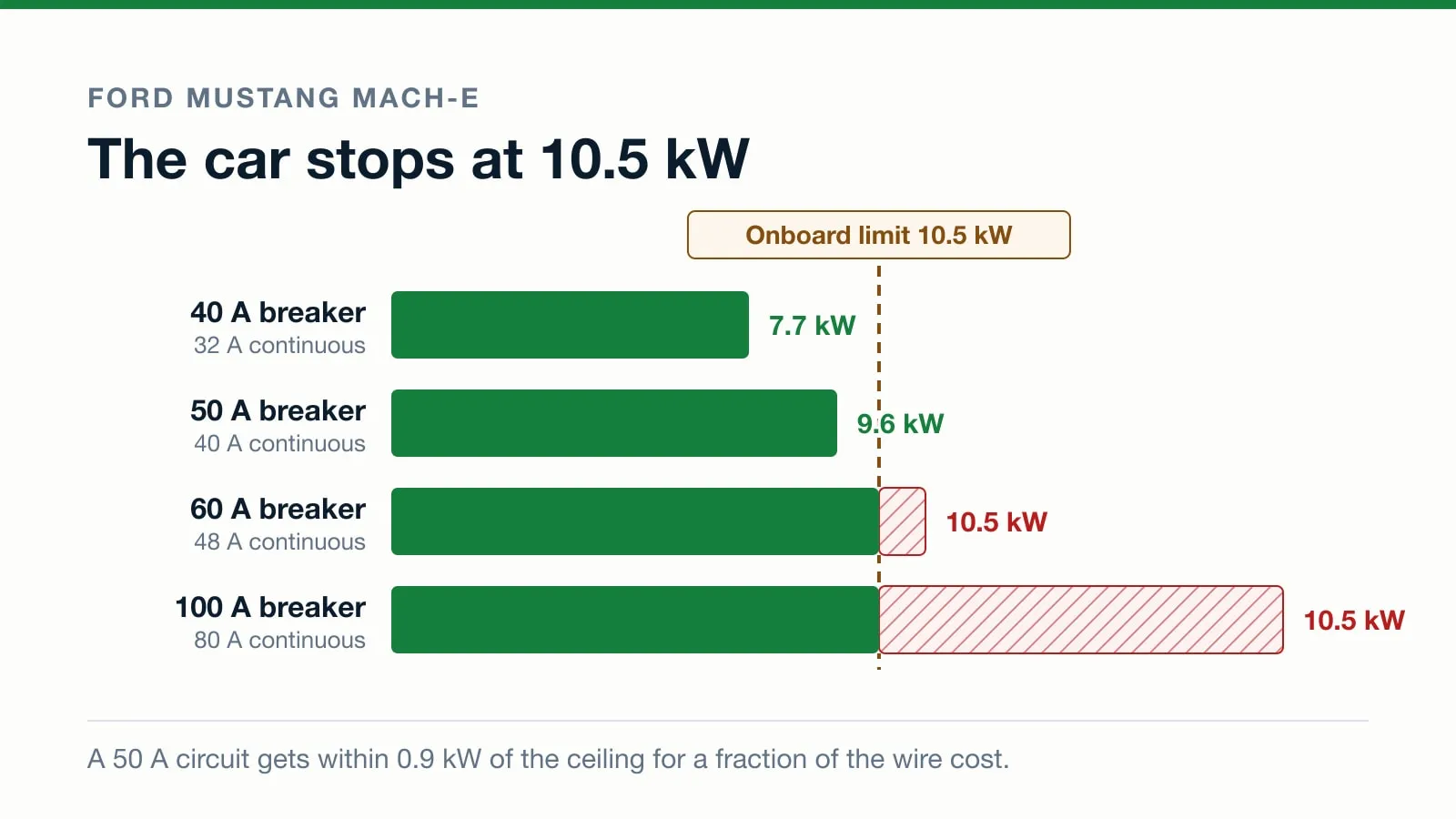
Its onboard charger tops out at 10.5 kW — a figure that falls between two standard circuits rather than landing neatly on one. That gap is where the buying decision lives.
Why 48 amps does not mean 11.5 kW here
Most onboard chargers are described by their current: 48 A at 240 V, which is 11.5 kW. The Mach-E is described by its power instead, and the two do not reconcile.
The car will accept up to 48 A, but its converter is rated at 10.5 kW. So on a 60 A circuit capable of supplying 11.5 kW, the car draws 10.5 and leaves the remaining kilowatt untouched.
This sounds like a technicality. It is the reason a 50 A circuit is a genuinely good answer for this car, where for a Model Y it would be a compromise.
| Circuit | Continuous | Circuit can supply | Mach-E actually draws |
|---|---|---|---|
| 40 A | 32 A | 7.7 kW | 7.7 kW |
| 50 A | 40 A | 9.6 kW | 9.6 kW |
| 60 A | 48 A | 11.5 kW | 10.5 kW |
| 100 A | 80 A | 19.2 kW | 10.5 kW |
The step from a 50 A circuit to a 60 A one buys 0.9 kW. That is the entire prize, and it is worth weighing against what the heavier conductor costs on your particular run.
What each circuit restores overnight
At roughly 3.0 miles per kWh, a realistic all-season average for a Mach-E:
| Circuit | Power drawn | Miles per hour | Added in 10 hours |
|---|---|---|---|
| 20 A | 3.8 kW | ~11 | ~110 |
| 40 A | 7.7 kW | ~23 | ~230 |
| 50 A | 9.6 kW | ~29 | ~290 |
| 60 A | 10.5 kW | ~31 | ~315 |
Twenty-five miles separate the last two rows over a full night. For most owners that is a rounding error against a battery that started the night 60% full.
The case for a NEMA 14-50
This is the car where the plug-in option is most defensible.
A NEMA 14-50 receptacle sits on a 50 A circuit with a 40 A continuous ceiling — 9.6 kW, or 91% of everything the Mach-E can take. In exchange you get a unit you can unplug and take to a new house, an outlet that is useful for other things, and a cheaper install on most runs.
50 A plug-in vs 60 A hardwired for a Mach-E
Pros
- Delivers 9.6 kW, within 0.9 kW of the car’s ceiling
- A plug-in unit moves house with you and is replaceable without an electrician
- Lighter conductor, which is where the saving actually is on a long run
- Less panel capacity consumed, which can avoid a service upgrade entirely
Cons
- Gives up about 25 miles per overnight charge against a 60 A circuit
- A 14-50 receptacle needs GFCI protection in most recent code editions
- No headroom for a future EV that can use the full 48 A
- Cheap receptacles are a real failure point — this is not the place to save $15
The receptacle point in that last column is not a throwaway. A NEMA 14-50 built for an occasional caravan hookup is not built for 40 A every night for ten years, and the failures show up as heat damage at the contacts. If you go plug-in, the receptacle should be an industrial-grade one. The full comparison is here.
The circuit behind the number
Charging is a continuous load — three hours or more — so the circuit and its breaker are sized at 125% of the current. 40 A continuous needs a 50 A breaker; 48 A needs 60 A. Same 1.25 that sizes every EV circuit.
Conductor size follows the breaker and then grows with distance. On a 50 A circuit, 8 AWG copper is the usual starting point, and it holds the 3% voltage -drop guideline considerably further than most people assume.
Connector and charger choice
North American Mach-E cars use J1772 for AC charging, with NACS adapters available for the fast-charging network. Any Level 2 charger works.
Ford’s own Connected Charge Station is a competent 48 A unit and there is nothing wrong with it — but the car charges at 10.5 kW from any Level 2 charger on the same circuit. Warranty, cable length and price are the things that actually differ.
The bottom line
Size to 10.5 kW, and notice that a 50 A circuit gets you to 9.6 of it.
For most Mach-E owners the 50 A plug-in install is the better spend: 91% of the car’s capacity, a cheaper run, less panel capacity consumed, and a unit that is not welded to the wall. Step up to 60 A if the run is short enough that the conductor barely costs more, or if a second EV with a real 48 A appetite is coming.
Either way, do not pay for 80 A. The car stops at 10.5 kW, and it will not notice.
Frequently asked questions
What size circuit does a Mustang Mach-E need?
A 50 A breaker at 40 A continuous delivers 9.6 kW, which is within 0.9 kW of everything the car can take. A 60 A circuit reaches the full 10.5 kW but the gain is roughly 8 miles per hour, and it costs meaningfully more on a long run.
How many kW can a Mach-E accept on AC?
10.5 kW. The car will draw up to 48 A at 240 V, but its onboard charger caps the power at 10.5 kW rather than the 11.5 kW that current would otherwise represent.
Can I use a NEMA 14-50 outlet for a Mach-E?
Yes, and it is a good fit for this car. A 14-50 sits on a 50 A circuit with a 40 A continuous ceiling, which delivers 9.6 kW — most of the Mach-E's capacity, from a plug-in unit you can take with you.
Is the Ford Connected Charge Station worth it?
It is a competent 48 A unit, but so are many others. The Mach-E charges at the same rate from any Level 2 charger on the same circuit, so choose on warranty, cable length and price rather than on the badge.
How long does a Mach-E take to charge at home?
An extended-range car takes roughly 10 hours from near-empty on a 50 A circuit and about 9 on a 60 A circuit. Both fit inside an overnight charge, which is why the difference matters less than it sounds.
Why does 48 amps not give 11.5 kW on this car?
Because the onboard charger is rated in power, not current. It will accept 48 A but converts at up to 10.5 kW, so the last kilowatt the circuit could supply is never drawn.
Sources
- Ford, Mustang Mach-E charging and range specifications — Onboard AC charger rating for North American models. Figures vary by model year and trim; verify against your own vehicle's documentation.Accessed 16 August 2026.
- Recharged, How to charge a Ford Mustang Mach-E at home — Cross-check on the 10.5 kW onboard rating and the 48 A current draw.Accessed 16 August 2026.