What Size Breaker Does an EV Charger Need?
A 32 A charger needs a 40 A breaker, a 48 A charger needs 60 A. Here is the rule that produces those numbers, why sizing to exactly 100% fails months later, and what the breaker does not decide.
The answer is a single multiplication, and almost every installation that gives trouble later got it wrong in the same direction.
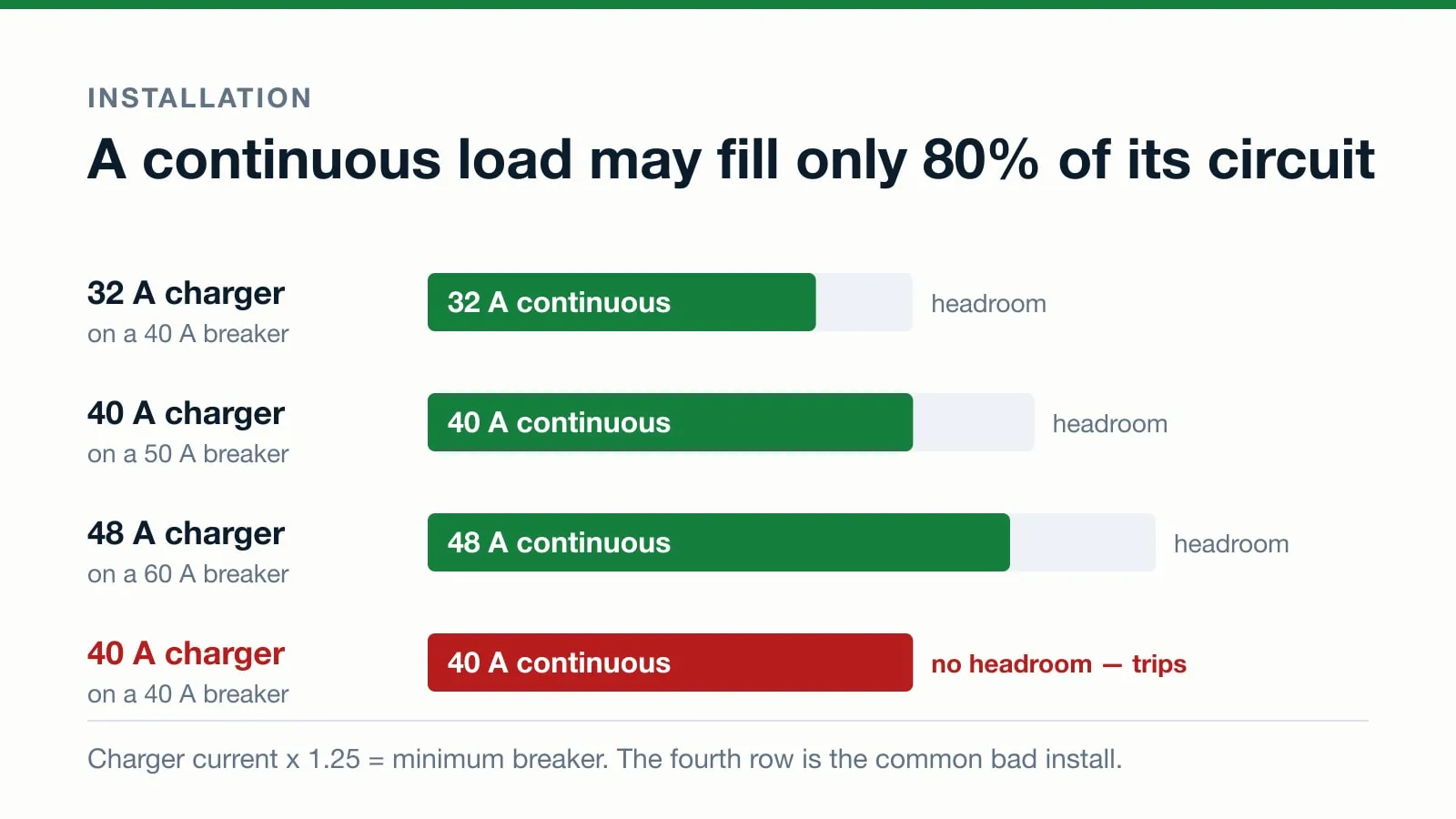
Multiply the charger’s continuous current by 1.25. That is your minimum breaker size. A 32 A charger needs 40 A; a 40 A charger needs 50 A; a 48 A charger needs 60 A.
The rest of this page is why that factor exists, what it does not cover, and the one mistake that turns a nuisance into a fire risk.
The table
| Charger draws | Minimum breaker | Typical copper conductor | Power at 240 V |
|---|---|---|---|
| 16 A | 20 A | 12 AWG | 3.8 kW |
| 24 A | 30 A | 10 AWG | 5.8 kW |
| 32 A | 40 A | 8 AWG | 7.7 kW |
| 40 A | 50 A | 8 AWG | 9.6 kW |
| 48 A | 60 A | 6 AWG | 11.5 kW |
The two bold rows cover the overwhelming majority of homes. The conductor column is a starting point for a short run in ordinary conditions, not a specification — distance, ambient temperature and how many cables share a conduit all move it, and that is its own subject.
Read the table the other way and it answers the more common question. If you already have a 40 A circuit, the largest charger it can carry continuously is 32 A. Not 40.
Where the 1.25 comes from
A breaker is a thermal device. It tolerates its rated current briefly and trips on sustained current near that rating, because sustained current is what heats conductors.
The electrical code therefore defines a continuous load as one drawing current for three hours or more, and requires the branch circuit and its overcurrent device to be sized at 125% of that load. Car charging is the definitive example — it runs all night.
You will also see this written as the 80% rule, which is the same statement inverted: a circuit may carry a continuous load of no more than 80% of its rating. 1 ÷ 1.25 = 0.8. Same arithmetic, and both phrasings appear in manufacturer documentation.
The failure this prevents
A 40 A charger on a 40 A breaker is the classic bad install. It is not obviously wrong — the numbers match — and it usually works for weeks.
Then it starts tripping, and it starts in warm weather. Breakers are calibrated at a reference temperature, and a panel in a hot garage sits closer to its threshold before the charger draws a single amp. What passed in February fails in July, which is why the owner blames the charger and the electrician blames the weather.
Nothing is faulty. The circuit was never big enough.
What the breaker does not decide
This is where the arithmetic stops helping, and it catches people who have done the sizing correctly.
The breaker does not set your charging speed. Your actual rate is the lowest of three separate limits: the circuit, the charger’s configured current, and the car’s onboard AC charger. Fit a 60 A circuit to a car whose onboard charger tops out at 7.7 kW and it will charge at 7.7 kW — the wall box cannot push what the car will not accept. The car-by-car guides give that ceiling for specific models, and it is worth checking before you settle on 48 A.
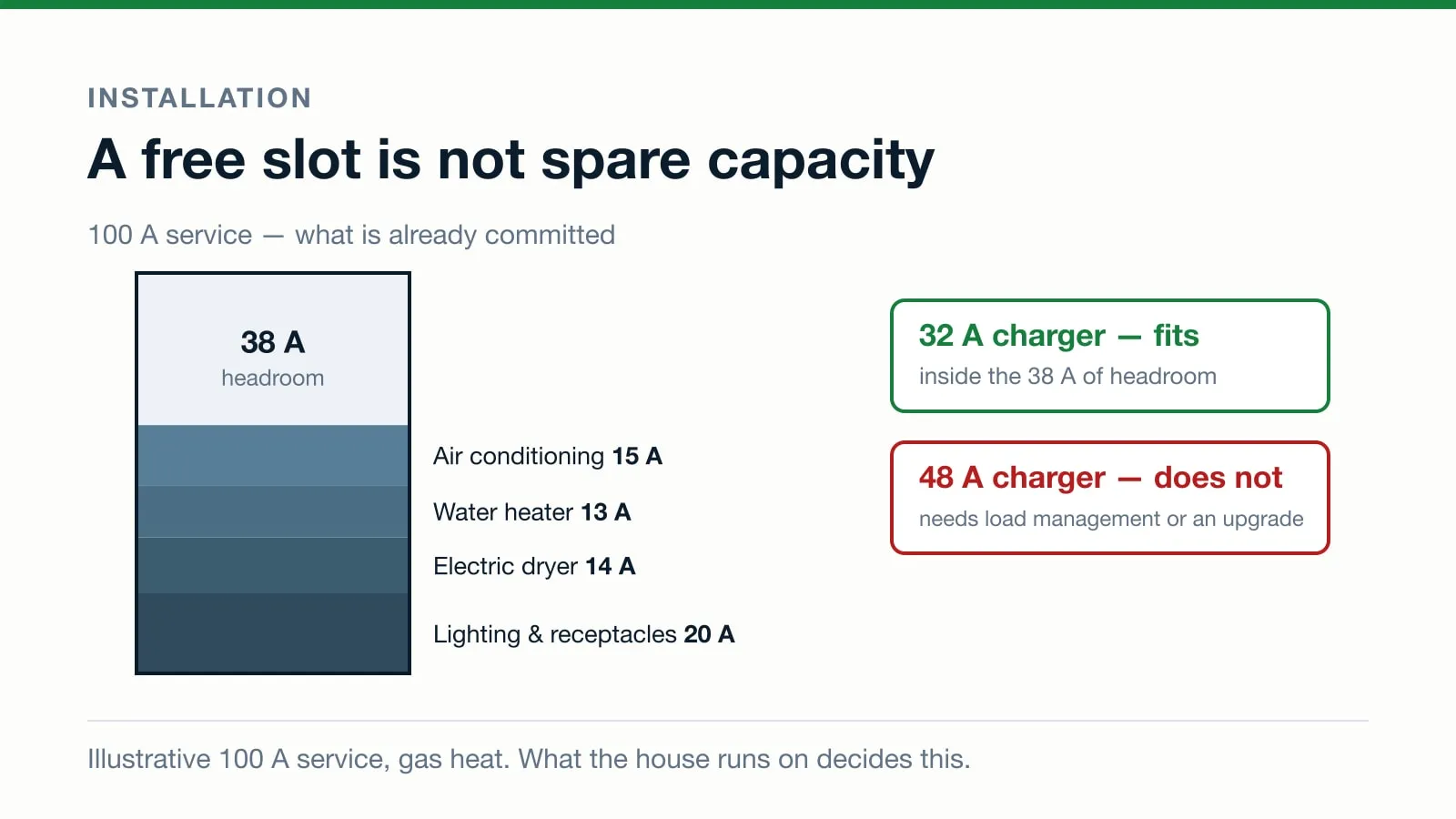
The breaker does not tell you the panel can feed it. A free double slot is not spare capacity. Whether your service can carry another 60 A circuit is a load calculation, and it is a separate question from breaker sizing — one that decides the cost of the whole job.
The breaker does not choose plug-in or hardwired for you — but it constrains it. A NEMA 14-50 receptacle sits on a 50 A circuit, so its continuous ceiling is 40 A. Wanting the full 48 A means a 60 A circuit, and that means hardwiring.
Whether you want that 48 A at all is a separate question, and the answer is no more often than people expect — 32 amps vs 48 amps works through what each one actually restores overnight.
Two-pole, and nothing else on it
Two details that are not really sizing but get asked in the same breath.
It has to be a two-pole breaker. A 240 V circuit draws from both legs of the split-phase supply and needs a device that opens both simultaneously. Two single -pole breakers with a handle tie is not the same thing and will not pass.
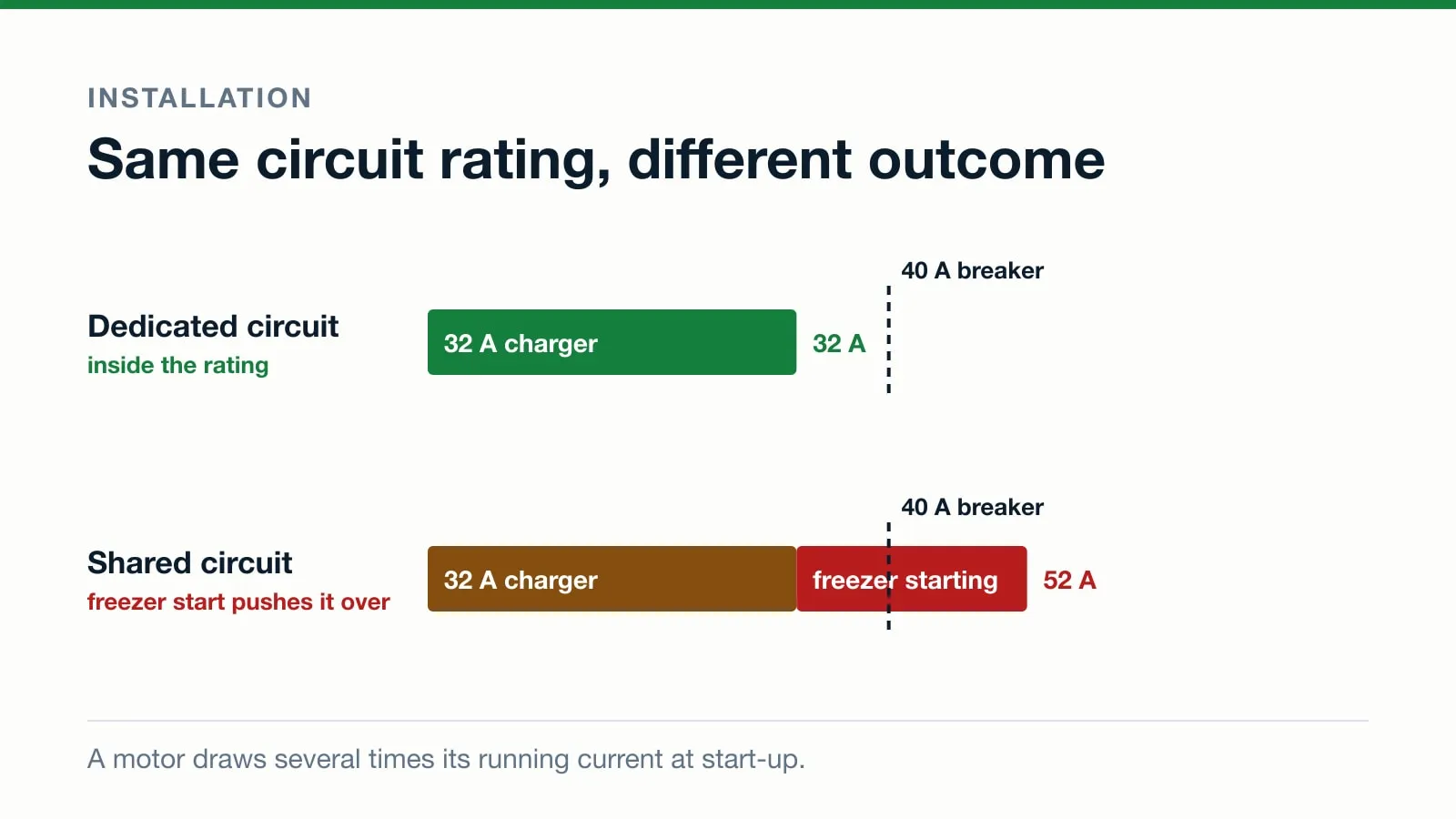
It has to be the only thing on the circuit. Under NEC 625.40, an outlet supplying EV charging equipment above 16 A or 120 V requires an individual branch circuit. No shared receptacles, no garage lighting. Beyond the code, a shared circuit is the second most common source of trips: the charger alone fits inside the rating, and the charger plus a freezer compressor starting does not.
When you cannot have the circuit you want
If the load calculation says there is no headroom for 60 A, you have three options and only one of them is expensive.
Turning the charger down vs upsizing the service
Pros
- Almost every Level 2 charger has a configurable current limit — a menu setting, not hardware
- Dropping 40 A to 32 A costs about six miles of range per hour, invisible over a twelve-hour night
- Load-management devices throttle the charger when the house draws heavily, for a few hundred dollars
- None of these require utility coordination or a meter swap
Cons
- A service upgrade is $1,500–$3,500 and takes weeks to schedule
- A throttled charger occasionally charges slower than advertised, which some owners dislike
- Load management adds a networked device that can fail
- If a second EV or a heat pump is coming, the upgrade may be worth doing once
The configurable limit is the part people forget they have. A charger sold as 48 A is usually a 48/40/32/24/16 A charger, and the installer sets it to match the circuit you can actually have. Buying the bigger unit and configuring it down is a reasonable way to leave room for a future service upgrade — as long as nobody quietly sets it back to 48 A on a 40 A circuit.
The one thing never to do
Do not fit a larger breaker to stop the tripping.
The breaker protects the conductor, not the charger. A 60 A breaker on wire rated for 40 A means the wire can carry 55 A indefinitely without the breaker ever noticing — inside a wall cavity, where nobody sees the heat. The protective device that would have caught it has been removed.
If a bigger breaker was fitted without new conductors, that is not a fix. Get it corrected.
Which code applies to you
Worth knowing before you quote a rule at an inspector.
The National Electrical Code is republished every three years, but it carries no force until a state or city adopts it — and adoption runs years behind. A small group of states have moved to the 2026 edition; most are on 2023 or 2020; a few remain older still.
Your permit is issued against whichever edition your jurisdiction has adopted. That decides whether a receptacle needs GFCI protection, what marking is required, and which conductor rules apply. The answer is a phone call to the inspecting authority, and any electrician who pulls permits locally already knows it.
The bottom line
Multiply by 1.25 and round up to a real breaker size, or let the calculator do it. Give the circuit its own two-pole device and nothing else on it. Match the charger’s configured current to the circuit you can genuinely have, rather than to the number on the box.
And treat the sizing table as the starting point of a conversation with a licensed electrician, not as a substitute for one. Conductor selection depends on material, insulation rating, ambient temperature, bundling and distance — which is exactly why this work is licensed.
Frequently asked questions
What size breaker do I need for a 32 A EV charger?
A 40 A two-pole breaker. Any load running three hours or more is a continuous load, and the circuit must be sized to 125% of it — 32 × 1.25 = 40. A 32 A charger on a 40 A breaker is the most common residential arrangement in the US.
What size breaker does a 48 A charger need?
A 60 A two-pole breaker, and conductors rated for it. This is the point where a NEMA 14-50 receptacle stops being an option, because a 14-50 sits on a 50 A circuit with a 40 A continuous ceiling.
Can I put a 40 A charger on a 40 A breaker?
No. It will appear to work and then start tripping, often once the weather warms, because breakers are thermally calibrated. A 40 A continuous load requires a 50 A circuit.
Can I just fit a larger breaker to stop the tripping?
Not on its own. The breaker protects the conductor, not the charger. Fitting a 60 A breaker on wire rated for 40 A removes the only device that would notice the wire overheating inside a wall. The conductor has to be upsized with it.
Does my EV charger need its own breaker?
Yes. Under NEC 625.40, an outlet supplying EV charging equipment above 16 A or 120 V requires an individual branch circuit — nothing else on it. Sharing with a freezer or garage lighting is the second most common cause of nuisance tripping.
Which edition of the electrical code applies to me?
The one your state or city has adopted, which is often not the newest. A handful of states are on the 2026 NEC, most are on 2023 or 2020, and a few remain older. Your permit is issued against the adopted edition, so ask the inspecting authority rather than assuming the latest rules apply.