How Much Does It Cost to Install a Home EV Charger?
Real installation invoices, not averages: what a Level 2 home EV charger costs to install in 2026, what drives the price up, and where the money actually goes.
HomeEnergyX may be supported by display advertising. Advertising does not influence our calculations or conclusions. This page contains no affiliate links.
Ask five electricians what it costs to install a home EV charger and you will get five numbers between $600 and $6,000 — all of them honest. The spread is not padding; it is the difference between a charger going on the wall directly behind your panel and one going on the far side of a detached garage.
This guide breaks the job into the four things that actually move the price, and shows which of them you can influence.
The short answer
For a typical single-family home in 2026, budget $1,200 to $3,000 all in for a professionally installed job, split roughly:
| Line item | Typical range |
|---|---|
| Level 2 charger (hardware) | $400 – $900 |
| Electrician labour | $400 – $1,100 |
| Materials (wire, conduit, breaker) | $100 – $450 |
| Permit and inspection | $50 – $300 |
| Trenching, if the run is outdoors (only if needed) | $300 – $2,000+ |
| Panel upgrade 100 A → 200 A (only if needed) | $1,500 – $3,500 |
The first four lines are predictable. The last two are what turn a $1,400 job into a $5,000 one, which is why every quote should start with a load calculation rather than a charger recommendation.
Simple installs — charger near the panel, service with headroom — genuinely land under $1,500. That is the case a lot of published averages quietly assume.
What actually drives the price
1. Distance from the panel
This is the single biggest variable. Copper is expensive and labour scales with difficulty, not with feet.
- Under 20 ft, same room as the panel: the easy case. Half a day, minimal wire.
- 20–75 ft through a finished wall or attic: expect fishing wire, drywall patches and another $250–$600.
- Detached garage: now you are trenching. Add $300–$2,000+ depending on whether the path is lawn, gravel or a concrete driveway.
2. Your panel’s spare capacity
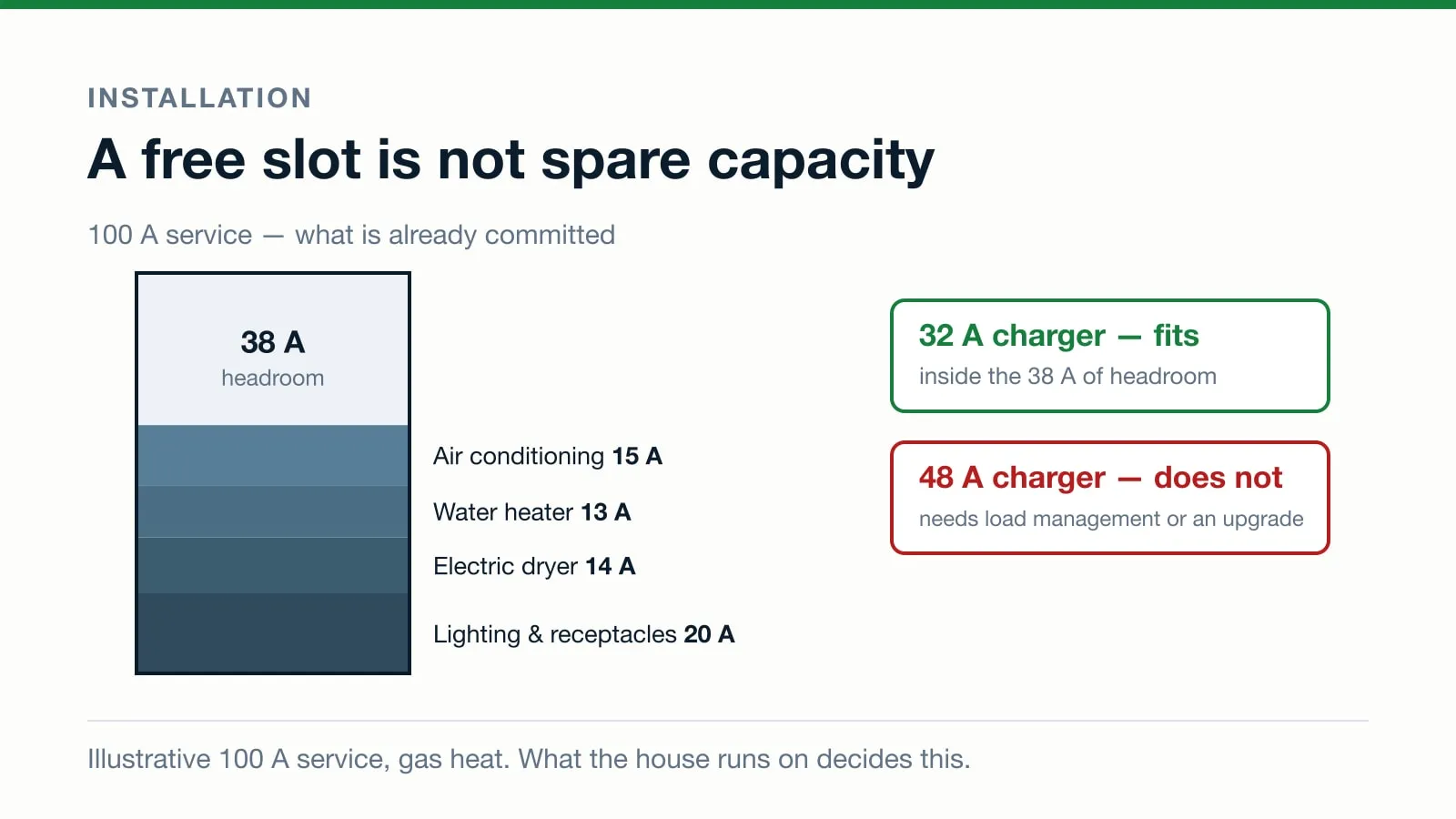
An electrician runs a load calculation against your service size. Three outcomes:
- Free space and headroom. Add a two-pole breaker and go. No extra cost.
- No physical space, but headroom exists. A tandem breaker or a small subpanel solves it for $200–$700.
- Not enough headroom. Either a service upgrade at $1,500–$3,500, or — much cheaper — a load management device that throttles the charger when the dryer and oven are running.
Service upgrade vs load management
Pros
- Load management costs $250–$500 installed, versus $1,500–$3,500 for a 100 A to 200 A upgrade
- No utility coordination, no meter swap, no waiting weeks
- Most devices are NEC 750-compliant and satisfy inspectors
Cons
- Charging can slow briefly when the house draws heavily
- Adds one more networked device that can fail
- A service upgrade adds headroom for a heat pump or second EV later
3. Hardwired or plug-in
A NEMA 14-50 receptacle feels cheaper because you can unplug the charger and take it with you. In practice the installation cost is nearly identical, and hardwiring buys you two things: the full 48 A that a 60 A circuit allows, and one fewer connection point to overheat. If you go plug-in, insist on an industrial-grade receptacle — the $12 hardware-store version is a known failure point.
4. Where you live
Permit fees, prevailing labour rates and inspection scheduling vary enormously. A permit that costs $60 and clears in three days in one county can cost $250 and take three weeks in the next one.
Hardware: what to actually buy
Charger prices have flattened. Above roughly $600 you are paying for smart-home integrations rather than for faster charging.
What to specify, rather than which brand to buy. We have not bench-tested chargers, so we are not going to rank them. What we can tell you is which specifications actually change the outcome:
| Specification | What to look for | Why it matters |
|---|---|---|
| Adjustable current | Selectable from ~16 A up to the unit’s maximum | Lets you match the charger to the circuit you can actually have, instead of the other way round |
| Amperage | 32 A covers most households; 48 A needs a 60 A circuit | The circuit, not the charger, is usually the constraint |
| Hardwired or plug-in | Hardwired for outdoors or 48 A | See NEMA 14-50 vs hardwired |
| Cable length | Measure from the mounting point to the car’s port, then add slack | Too short is the most common regret; 25 ft covers most layouts |
| Enclosure rating | NEMA 4 or equivalent if mounted outdoors | Water ingress is the top weather-related failure |
| Safety certification | Listed by a recognised testing laboratory (UL or equivalent) | Non-certified units can fail inspection outright |
| Behaviour after a power cut | Resumes charging automatically | Matters more than any app feature |
Above roughly $600 you are generally paying for smart-home integration rather than for faster charging. Decide whether you want those features before you let them set your budget.
A 32 A charger adds about 25 miles of range per hour. Unless you routinely drive more than 200 miles a day, that is already more than enough overnight — the case for 48 A is mostly future-proofing for a second EV.
Three scenarios, and what drives each one
These are illustrative cost structures, not invoices we hold. They show how the same job lands at very different totals depending on one or two variables.
Easy case — attached garage, modern service, short run. Charger mounted close to a panel with spare capacity. Permit, a few hours of labour, minimal conductor. This is the case that lands under $1,500, and it is common in newer housing.
The panel problem — older service, no headroom. The load calculation fails. Here the decision is a service upgrade at $1,500–$3,500, or a load-management device at a few hundred dollars that throttles the charger when the house draws heavily. Choosing the second is usually the single largest saving available on the whole project.
The distance problem — detached garage. Now you are trenching, and the surface decides the price. Lawn is cheap; a concrete driveway means boring under it. $300 to $2,000+ on top of everything else.
Ask any quote to identify which of these three your house is. If the electrician cannot say, they have not done the load calculation.
How to bring the cost down
- Check what incentives still exist — the federal one is gone. The 30C federal charger credit lapsed for anything placed in service after 30 June 2026, so it cannot help you now. What remains is state and utility programmes, and those are worth real money in some service territories.
- Mount the charger near the panel even if it is not the most convenient wall. Ten feet of wire saves more than any hardware discount.
- Bundle the work. If an electrician is already coming for a panel or a heat pump circuit, the marginal cost of the charger circuit drops sharply.
- Skip the 48 A charger if your panel would need an upgrade to feed it. A 32 A unit on the existing service charges overnight just fine.
- Buy the charger yourself. Contractor markup on hardware is typically 15–30%.
What to ask your electrician
- What did the load calculation come out to, and can I see it?
- Is this quote for hardwired or a receptacle, and at what amperage?
- Does it include the permit and the inspection visit?
- What wire gauge and conduit are you using for this run?
- What happens to the price if the wall opens up and the path is worse than expected?
An electrician who answers all five without hesitating is worth paying slightly more for. One who quotes a flat price over the phone without seeing your panel is guessing — and you will pay for the guess later.
Frequently asked questions
How much does it cost to install a Level 2 EV charger at home?
Most homeowners pay between $1,200 and $3,000 all-in for a professionally installed Level 2 charger. A short run to a modern 200 A panel can land under $1,500; a long trench, an old panel or a required service upgrade pushes it past $4,000.
Do I need a permit to install an EV charger?
Almost everywhere in the US, yes. A dedicated 240 V circuit is a permitted job and the inspection is what protects you. Permit fees typically run $50 to $300 and are usually pulled by your electrician as part of the quote.
Is a plug-in charger cheaper than a hardwired one?
Slightly, and only if the outlet is easy to reach. A NEMA 14-50 receptacle costs about the same to install as hardwiring, but caps you at 40 A and adds a connection point that can overheat if a cheap receptacle is used.
Will I need to upgrade my electrical panel?
Only if a load calculation says so. Many homes with a 100 A service can add a charger by using a load-management device instead of a service upgrade. Going from 100 A to 200 A typically runs $1,500 to $3,500, so avoiding it is usually the largest single saving available.