What Size Wire Does an EV Charger Need?
8 AWG copper covers most 40 A circuits — until the run gets long. Here is the gauge for each circuit size, why distance changes the answer, and the voltage-drop maths nobody shows you.
Conductor sizing is the part of a home charger installation where the internet is least useful, because the honest answer starts with “it depends on the distance” and most sources skip that entirely.
Here is the short version, then the part that actually decides it.
Ampacity first: the floor
Every conductor has an ampacity — the current it can carry continuously without its insulation degrading. This sets the minimum gauge, and it is the number most tables stop at.
For copper with 75 °C-rated insulation, which is what modern THHN/THWN-2 and most terminations are:
| Circuit | Charger it serves | Copper | Ampacity at 75 °C |
|---|---|---|---|
| 20 A | 16 A | 12 AWG | 25 A |
| 30 A | 24 A | 10 AWG | 35 A |
| 40 A | 32 A | 8 AWG | 50 A |
| 50 A | 40 A | 8 AWG | 50 A |
| 60 A | 48 A | 6 AWG | 65 A |
Note the 40 A and 50 A rows share a gauge. 8 AWG copper carries 50 A, so it satisfies both — which is why an electrician may run 8 AWG and fit a 50 A breaker even when you asked for a 40 A circuit.
The temperature rating is not a detail. The same 8 AWG copper is rated 40 A at 60 °C and 55 A at 90 °C. Which column applies depends on the terminations at both ends — the breaker and the charger — not on the wire alone. Equipment listed only for 60 °C drags the whole circuit down to the 60 °C column, and that is how a conductor that “should” have been fine turns out not to be.
Then distance, which is what usually decides it
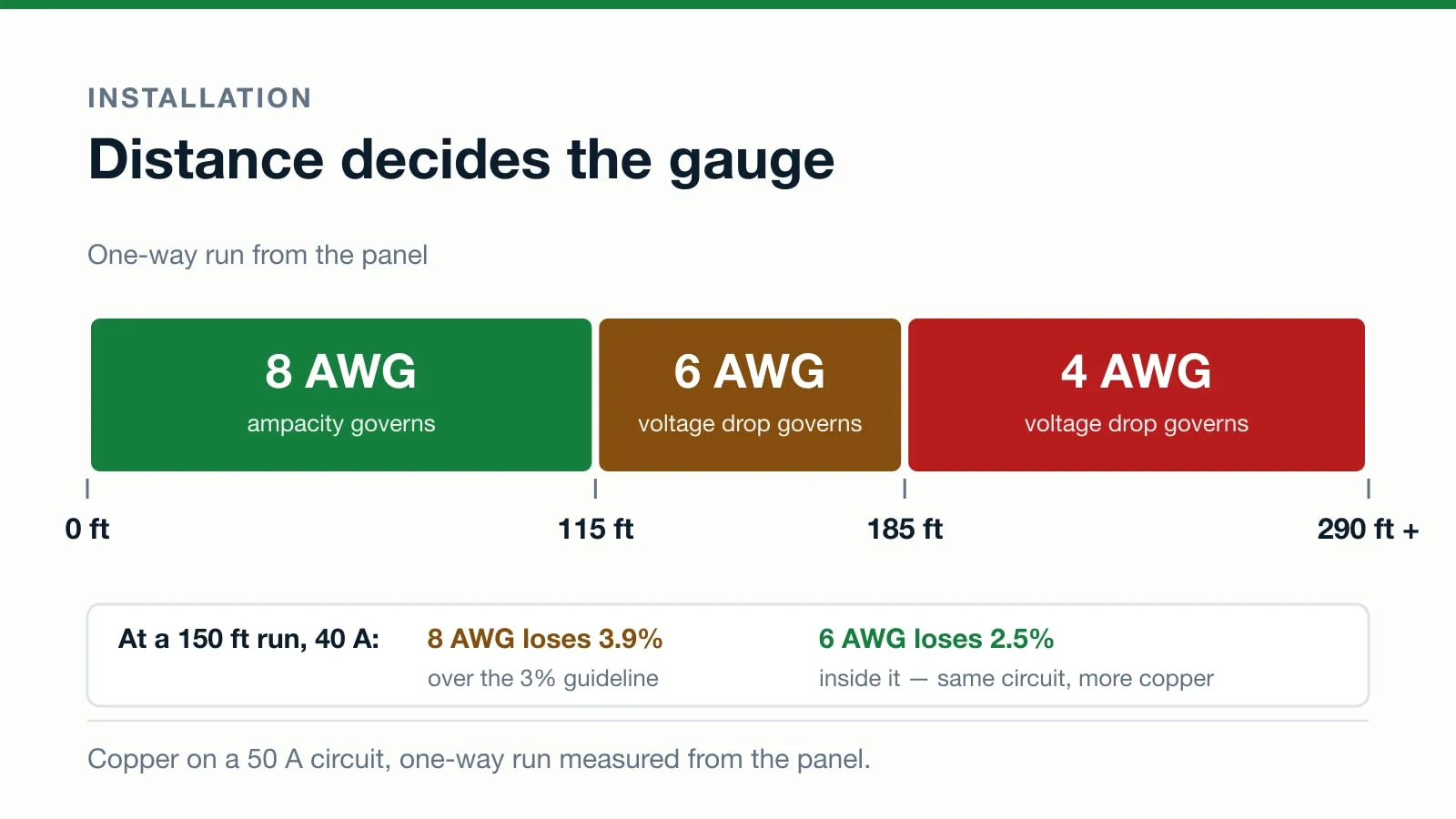
Ampacity gives you a floor. On a long run — past roughly a hundred feet at 40 A — the gauge that actually gets installed is set by voltage drop.
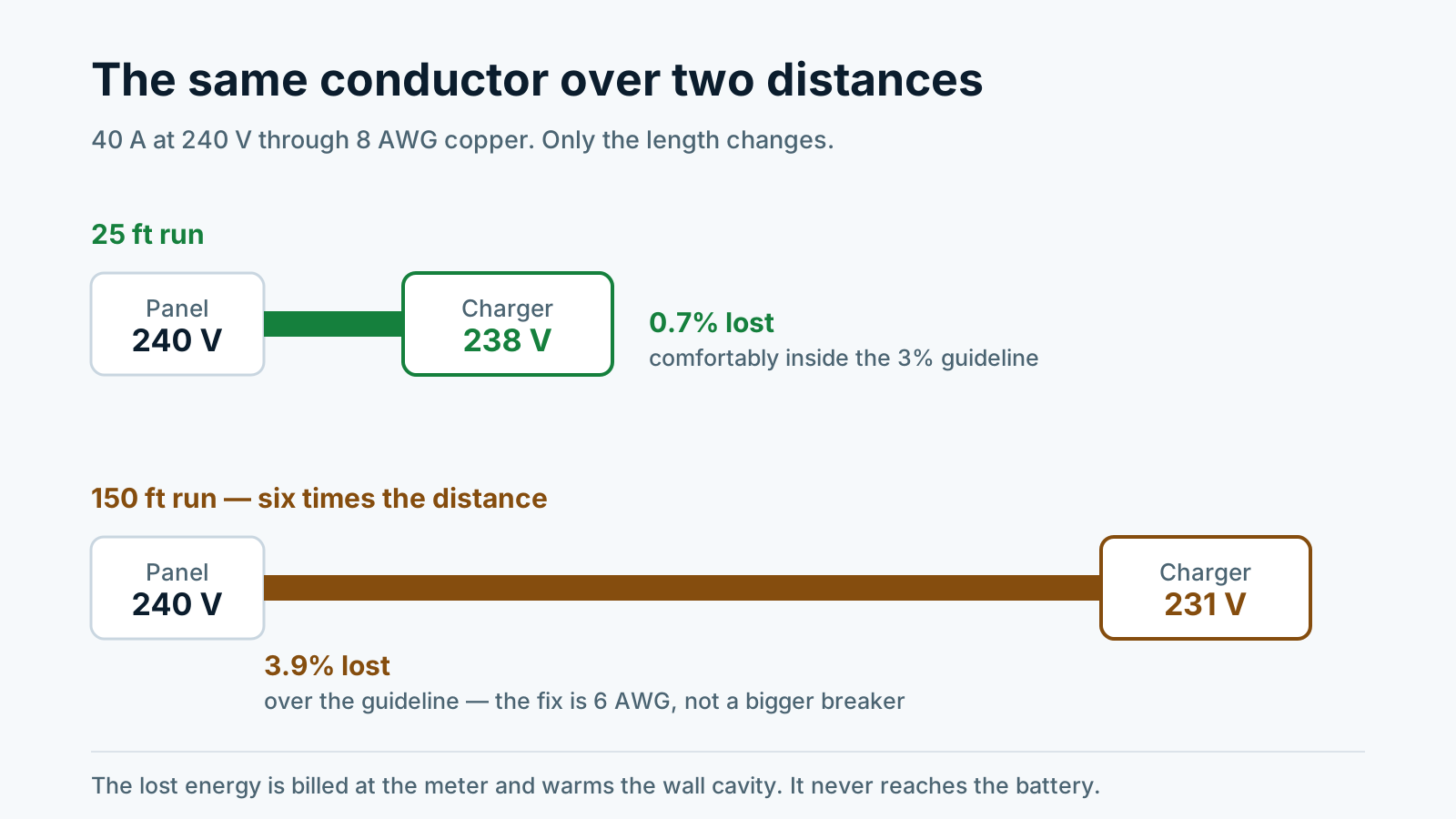
Current flowing through a conductor loses voltage along the way, in proportion to length. The code does not mandate a limit, but it recommends keeping a branch circuit under 3%, and that recommendation is what electricians size to.
Worked, for a 40 A load on 8 AWG copper at 240 V:
| One-way run | Approximate drop | Voltage at the charger |
|---|---|---|
| 25 ft | ~0.7% | ~238 V |
| 50 ft | ~1.3% | ~237 V |
| 75 ft | ~2.0% | ~235 V |
| 100 ft | ~2.6% | ~234 V |
| 150 ft | ~3.9% | ~231 V |
The 3% guideline holds out to about 115 feet on this conductor. Past that the fix is more copper: 6 AWG at 150 feet brings it back to roughly 2.5%.
Two things to notice. Measure the one-way run — the calculation already accounts for the return path. And the drop scales with current, so a charger configured to 32 A instead of 40 A on the same wire drops proportionally less.
What voltage drop actually costs you
It is not a safety problem at these levels. It is a metering problem.
The energy dissipated in the conductor is billed at your meter and never reaches the battery. A 5% drop on a circuit you use every night is roughly 5% more kilowatt-hours for the same miles — on top of the 10 to 15% you already lose in conversion and thermal management.
Some chargers also reduce their current when the voltage at their terminals sags, so a badly undersized long run can charge slower than the circuit suggests, with nothing visibly wrong.
Copper or aluminium
On a long run to a detached garage, aluminium is worth asking about. It is substantially cheaper per foot at the larger sizes, which is exactly where the cost lands.
The trade is that aluminium carries less current for a given gauge, so it has to be sized up — commonly two steps, so 6 AWG copper becomes 4 AWG aluminium. It also requires terminations listed for aluminium and antioxidant compound at the joints.
Aluminium on a long run
Pros
- Markedly cheaper per foot once you are into 6 AWG and larger
- Lighter, which matters when pulling a long conduit run
- Standard practice for service entrances, so electricians are used to it
Cons
- Two gauge steps larger for the same current, so the conduit grows too
- Terminations must be listed for aluminium, and joints need antioxidant
- A poor aluminium termination fails more readily than a poor copper one
- Some inspectors and some equipment simply will not accept it
This is not a decision to make from a web page. It is a reasonable thing to raise in a quote — “would aluminium make sense on this run?” — and then let the electrician answer for your specific conditions.
Conduit, burial and the rest of the run
For a detached garage the conductor is rarely the expensive part.
- Direct burial needs cable rated for it, at the depth your jurisdiction requires.
- Conduit adds material and labour but makes future pulls possible, which is worth something if a second EV or a workshop is plausible.
- Under a driveway means boring or cutting, and that is what turns a $600 trench into a $2,000 one.
The distance from the panel is the single biggest cost variable in the whole job, and it is mostly this.
What to ask for in a quote
Four questions, and any electrician who pulls permits will answer them without pausing:
- What gauge and material, and at which insulation temperature rating?
- What is the one-way run length you measured, and the calculated voltage drop?
- Are the terminations at both ends rated for the column you sized to?
- Conduit or direct burial, and at what depth?
A quote that names a gauge without naming a length has not been calculated. That is the one to be sceptical of — not because it is dishonest, but because the number was guessed and you are the one who pays if the guess was low.
The bottom line
Ampacity sets the floor: 8 AWG copper for most 40 and 50 A circuits, 6 AWG for 60 A. The calculator works your own run out. Distance sets the reality, and past roughly a hundred feet you should expect to go one size larger for voltage drop rather than for current.
None of this replaces a licensed electrician, and it is not meant to. It is meant to let you read the quote and recognise whether the run was measured or assumed.
Frequently asked questions
What size wire do I need for a 50 A EV charger circuit?
8 AWG copper satisfies ampacity for a 50 A circuit at the 75 °C rating, and it covers most installations outright. Carrying 40 A, it stays inside the 3% voltage-drop guideline to roughly 115 feet; past that, 6 AWG becomes the sensible choice.
What size wire for a 60 A circuit and a 48 A charger?
6 AWG copper for ampacity, which carries 65 A at 75 °C. Carrying 48 A it holds 3% out to roughly 150 feet; beyond that, 4 AWG is the usual upsize — for voltage drop rather than for current-carrying capacity.
Can I use aluminium wire for an EV charger?
Yes, and it is often cheaper on long runs, but it must be sized up — typically two gauge steps — and terminated with connectors and antioxidant compound rated for aluminium. This is not a place to improvise; it is a decision for the electrician doing the work.
How long is too long for an EV charger circuit?
There is no fixed limit. Voltage drop grows with distance, so the conductor is simply upsized until the drop is acceptable — under 3% for a branch circuit is the usual target. A detached garage 120 feet away is entirely doable; it just costs more copper.
Does voltage drop actually matter for charging?
It costs you money quietly. The energy lost in the conductor is billed at the meter but never reaches the battery, and the charger may also reduce current if the voltage at its terminals sags. It is not a safety issue at normal levels — it is a waste issue.
Can I use the wire that is already in the wall?
Only if an electrician confirms its gauge, insulation temperature rating and condition, and that it is on a circuit with nothing else. Reusing a dryer or workshop circuit is the single most common way people end up with an undersized EV circuit.