Does an EV Charger Need Its Own Dedicated Circuit?
Yes, and it is a code requirement rather than a recommendation. Here is what dedicated actually means, the two-minute test for whether yours is, and why sharing fails even when the maths looks fine.
This one has a short answer, and unusually for home charging it is not “it depends”.
Yes — and it is a code requirement. Under NEC 625.40, an outlet supplying EV charging equipment rated above 16 A or 120 V must be on an individual branch circuit that serves nothing else.
What is worth your time is the second half: why sharing fails even when the arithmetic looks comfortable, and how to check what you actually have.
What “dedicated” means precisely
One breaker. One conductor run. One load.
No other receptacles on the run. No garage lighting tapped off it. No switched outlet by the door. The circuit leaves the panel and terminates at the charger or at the receptacle serving it, and nothing else touches it.
That is stricter than most people picture, and it is why a perfectly good existing 240 V circuit — a dryer outlet, a workshop feed — usually cannot simply be reused. It is not the gauge that disqualifies it. It is the other things already on it.
The two-minute test
You do not need an electrician to find out what you have.
- Plug something visible into every outlet you can see in the garage — a lamp, a phone charger.
- Switch off the breaker you believe feeds the charging circuit.
- Walk the garage and the rooms sharing a wall with it. Check lights, outlets, the freezer, the door opener.
If anything else went dark, the circuit is shared. That is the whole test, and it settles the question before anyone quotes you for anything.
If the charger is not installed yet, run the same test on whichever circuit is being proposed for reuse.
Why sharing fails even when the sum looks fine
Here is the part the arithmetic hides, and it is why “the freezer only draws six amps, there is plenty of room” turns out to be wrong.
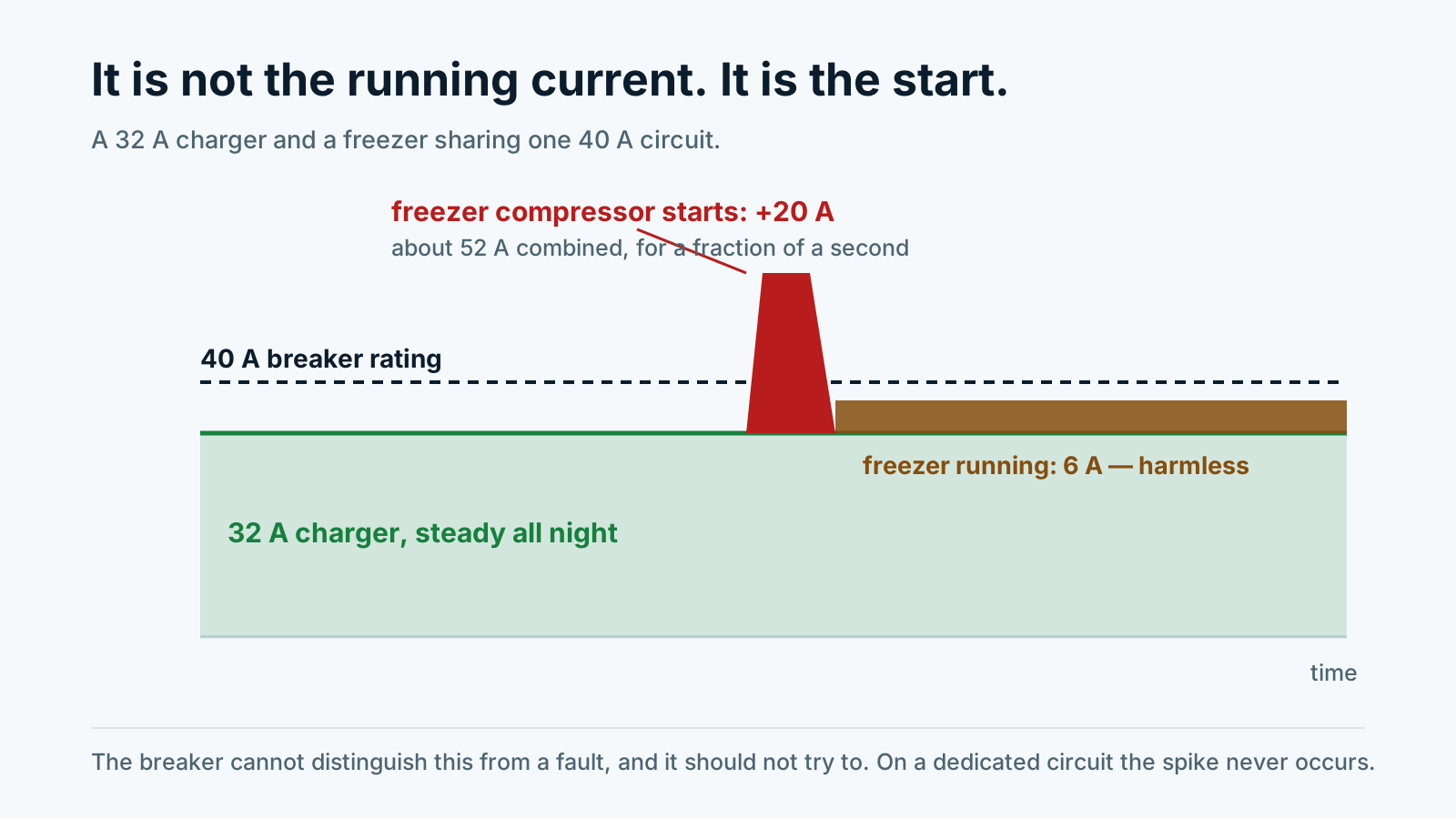
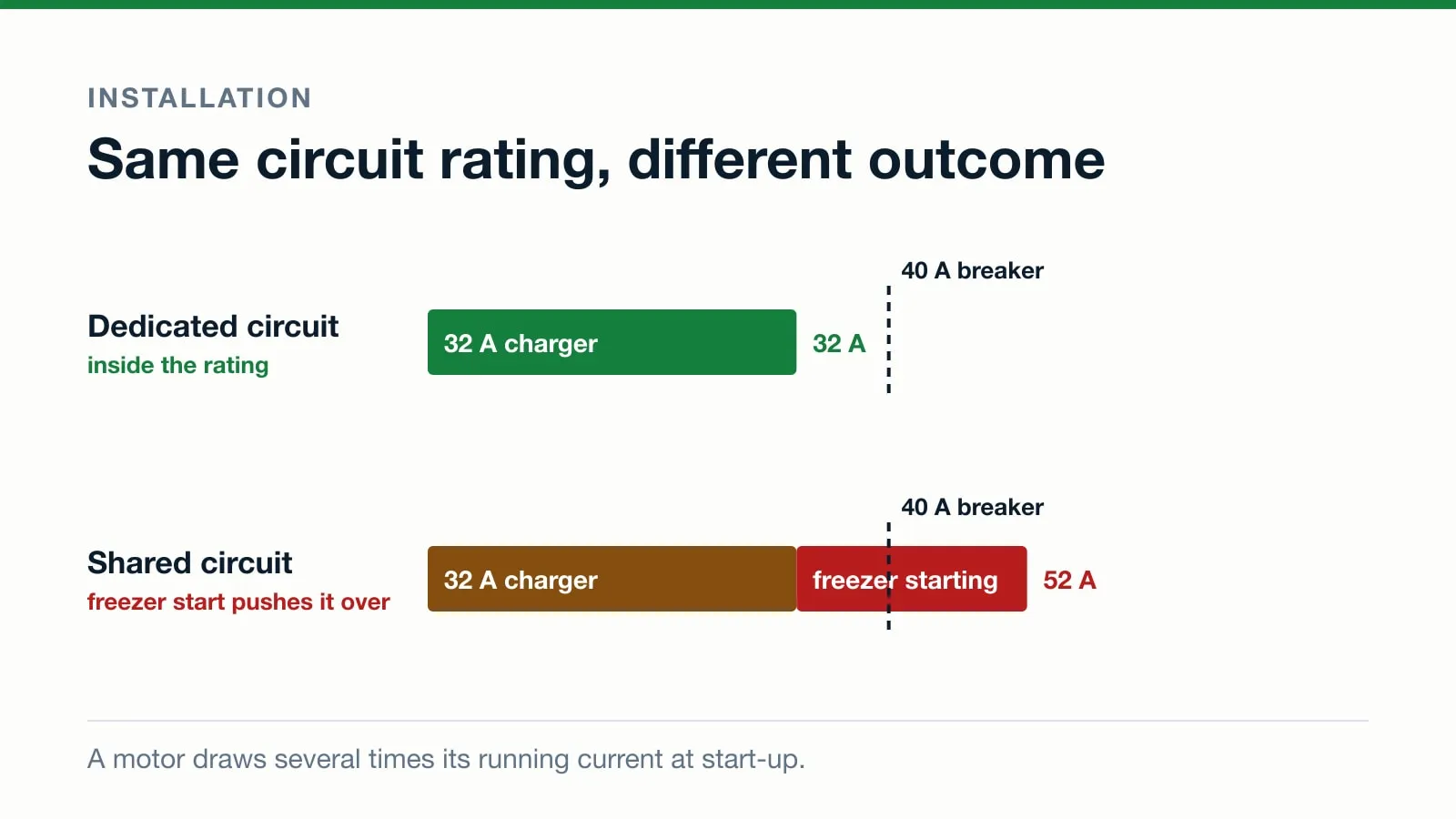
Motors draw several times their running current at start-up. A compressor that settles at 6 A can pull 20 A or more for a fraction of a second as it comes up to speed. A well pump or a compressor in a workshop is worse.
On a dedicated circuit that spike has nowhere to land, because nothing else is there. On a shared circuit it lands on top of a charger that is already drawing 32 A continuously, and the total briefly exceeds the breaker rating.
The result is the most frustrating failure pattern in home charging: trips that happen at apparently random hours, with no correlation to anything you were doing, because the trigger was a freezer cycling at 3 am.
The related mistake: reusing the dryer outlet
It is a 240 V outlet, it is already there, and it is rated 30 A. The temptation is obvious.
Reusing an existing 240 V outlet
Pros
- No new conductor run, which is where most of the installation cost sits
- Sometimes genuinely viable for a 24 A charger on a 30 A circuit
- Splitter products exist that interlock so only one appliance draws at a time
Cons
- A dryer circuit is sized for intermittent use, not eight hours nightly
- Sharing without an interlock breaches 625.40 and fails inspection
- The receptacle itself was never specified for continuous duty
- You lose the dryer while the car charges, unless the interlock is automatic
Interlocked splitters do exist and some are listed for the purpose. They are a reasonable answer for a renter or for a genuinely constrained panel. They are not a way to avoid a permit, and the installation still has to satisfy the inspector.
What this costs you if it is wrong
Three separate consequences, in ascending order of seriousness.
Nuisance trips, which is what most people notice — an unpredictable failure that is hard to diagnose because the cause is intermittent. The timing of the trip is what identifies it.
A failed inspection, if the work was permitted. That means paying an electrician to come back and run the circuit that should have been run first.
An unprotected conductor, if somebody responded to the trips by fitting a larger breaker instead of a dedicated circuit. That is the version that starts fires, and it is depressingly common as a “fix”.
Level 1 is the one genuine exception
The 625.40 requirement applies above 16 A or 120 V, so a Level 1 cable plugged into an ordinary 120 V household outlet is not covered by it.
That is a legal answer rather than a practical one. A Level 1 charger draws about 12 A continuously for twelve hours, which is 80% of a 15 A circuit before anything else is connected. Sharing it with a freezer or a workshop bench is how people discover the 80% rule the hard way.
If you are running Level 1 long-term — and for a lot of drivers that is entirely sufficient — it is still worth having that outlet on a circuit of its own.
The bottom line
One breaker, one run, one load. Test what you have by switching the breaker off and walking the garage, and do it before anybody quotes you.
If the circuit turns out to be shared, the answer is a new circuit rather than a larger breaker. That distinction is the difference between an installation that works quietly for a decade and one that becomes a recurring mystery.
Frequently asked questions
Does an EV charger legally need its own circuit?
Yes. Under NEC 625.40, an outlet supplying EV charging equipment rated above 16 A or 120 V must be on an individual branch circuit serving nothing else. It is a requirement, not best practice, and an inspector will fail an installation that shares.
What counts as a dedicated circuit?
One breaker, one conductor run, one load. No other receptacles, no lighting, no switched outlets. If flipping that breaker turns anything else off, it is not dedicated.
How do I test whether my circuit is shared?
Switch the breaker off and walk the garage and adjacent rooms checking lights, outlets and any freezer or workshop equipment. If anything else lost power, the circuit is shared. It takes about two minutes.
Can I plug a Level 1 charger into a normal outlet?
Legally yes, since 625.40 applies above 16 A or 120 V. Practically, that outlet should still not be shared with much else — a 12 A continuous draw alongside a freezer on a 15 A circuit is a common source of trips.
Why does a shared circuit trip when the total looks fine?
Because motors draw several times their running current for the first moments after starting. A freezer that runs at 6 A can pull 20 A or more on start-up, and that spike lands on top of the charger's steady draw.
Can I run two EV chargers on one circuit?
Not on an ordinary branch circuit. Two chargers need either two circuits or an energy-management system designed to share one supply between them, which is a specified product rather than an improvisation.