Why Your EV Charger Keeps Tripping the Breaker
A tripping breaker is a symptom, not a fault. Here is how to tell a genuine overload from a failing GFCI, a shared circuit, or a charger drawing more than its wire can carry.
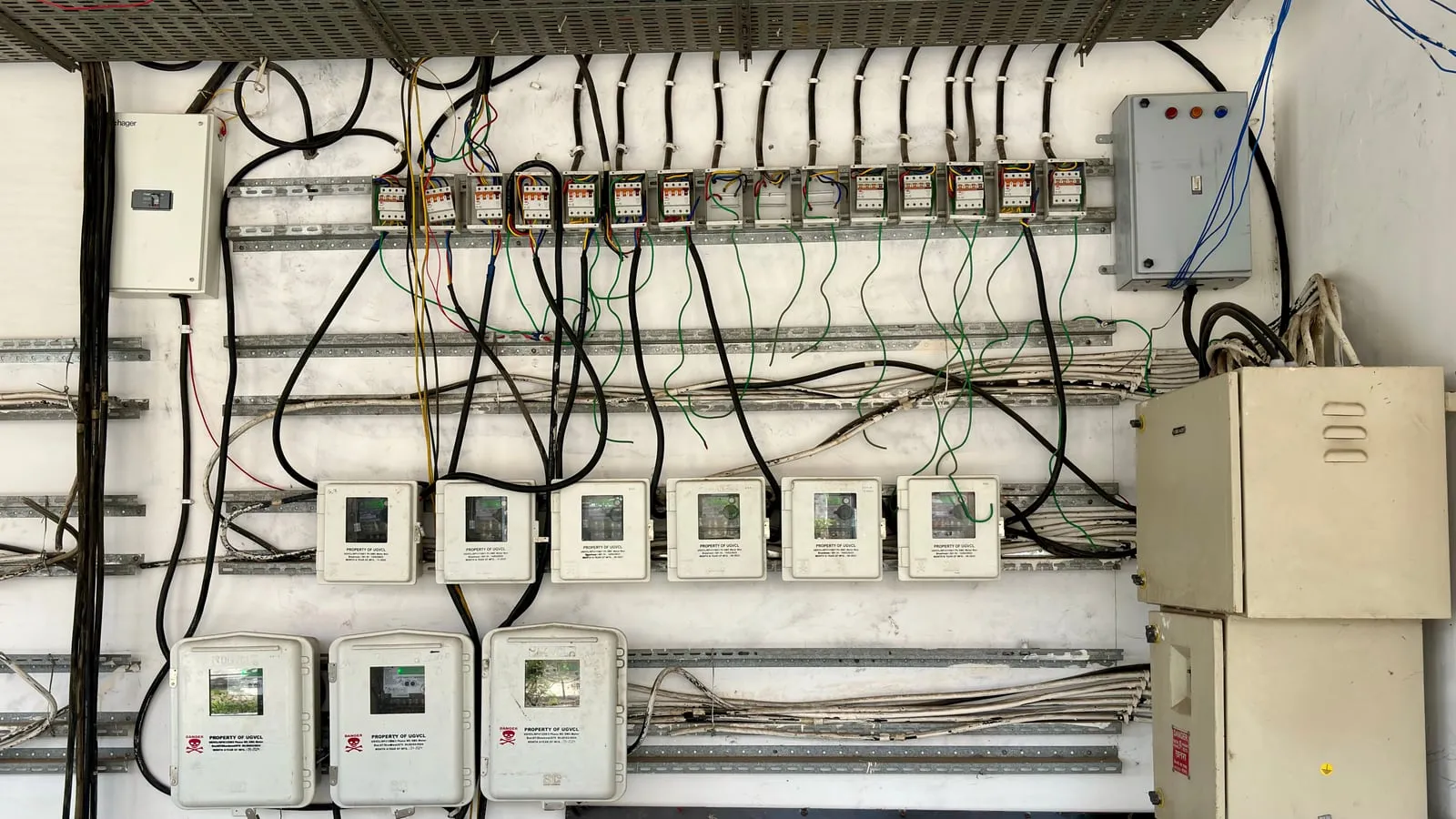
A breaker that trips is not malfunctioning. It is a protective device doing precisely what it was installed to do. The question is never “how do I stop it tripping” — it is “what is it protecting me from”.
There are four common causes, and they are distinguishable by when the trip happens. (If the breaker is holding and the charger simply refuses to deliver, that is a different diagnosis.)
Start with the timing
This single observation narrows it down faster than anything else.
| When it trips | Most likely cause |
|---|---|
| Instantly, every time | Wiring fault, or a genuine short |
| After 5–40 minutes | Thermal overload — circuit undersized for the draw |
| Randomly, sometimes hours in | Ground fault, or a shared circuit peaking |
| Only in rain or heavy damp | Moisture ingress at an outdoor connection |
| Only when the dryer or oven runs | Shared circuit, or a service at its limit |
Write down what you observe for three sessions before changing anything. The pattern is the diagnosis.
1. The 80% rule — by far the most common cause
This is the one that catches most people, and it is not a fault at all. It is sizing.
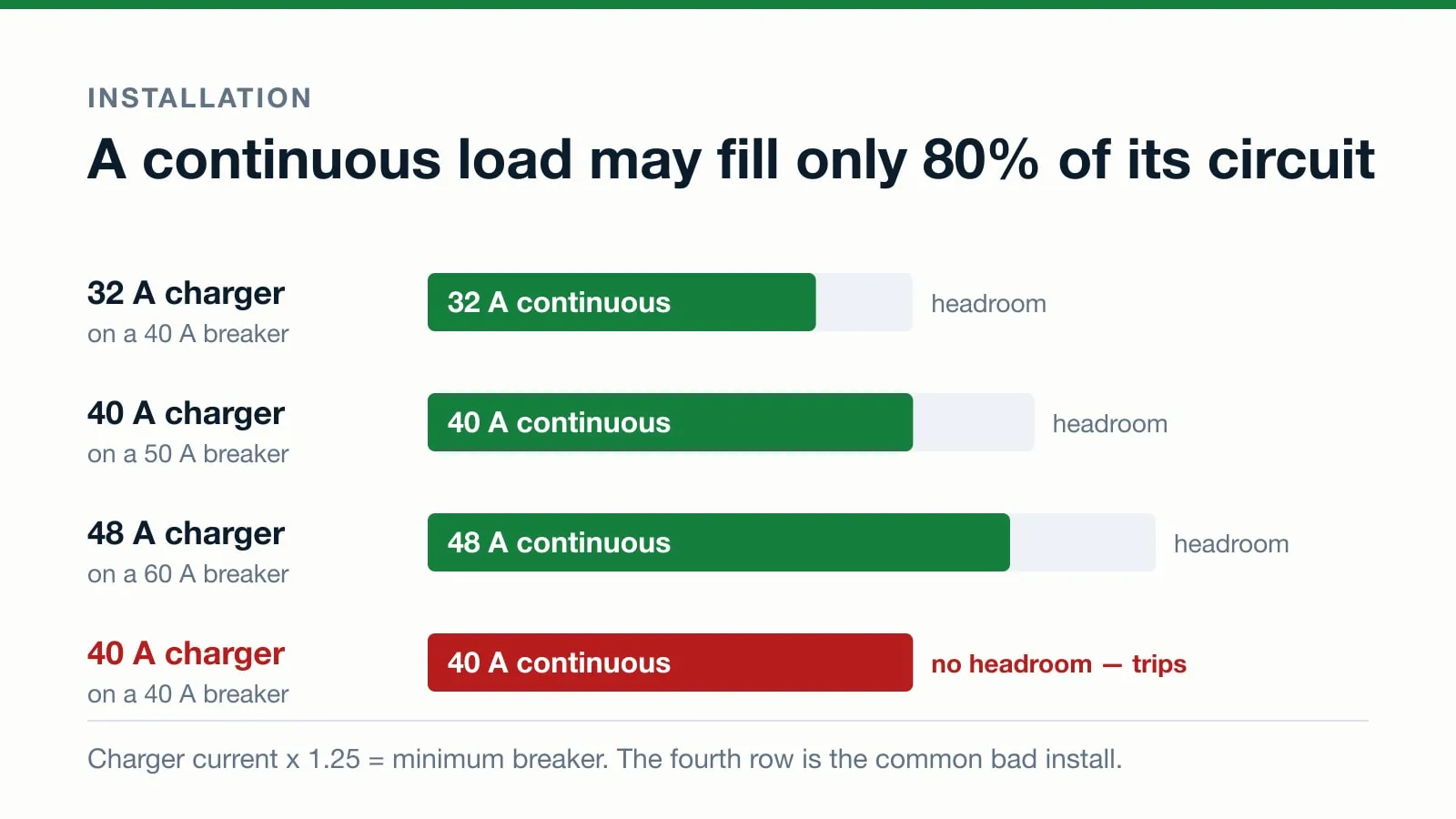
Under the electrical code, any load drawing current for three hours or more is a continuous load, and a circuit may only be loaded to 80% of its breaker rating for one. Car charging is the definitive continuous load — it runs all night.
So:
| Charger draw | Minimum circuit |
|---|---|
| 16 A | 20 A |
| 24 A | 30 A |
| 32 A | 40 A |
| 40 A | 50 A |
| 48 A | 60 A |
If someone installed a 40 A charger on a 40 A breaker, it will work for a while and then start tripping — often once the weather warms, because breakers are thermally calibrated and a hot garage lowers the threshold.
The fix is not a bigger breaker. It is either upsizing the whole circuit — wire included — or turning the charger down. Almost every Level 2 charger has a configurable current limit, and dropping from 40 A to 32 A costs you a couple of miles of range per hour that you will never notice overnight.
2. Someone fitted a larger breaker
If your trips stopped after an electrician “fixed” it and you did not also get new wire, stop and check what was done.
The breaker protects the wire, not the charger. A 60 A breaker on wire rated for 40 A means the wire can carry 55 A indefinitely without the breaker ever noticing. That current turns into heat inside a wall cavity, and the protective device that would have caught it has been removed.
This is the failure mode that causes fires. If a bigger breaker was fitted without new conductors, get it corrected.
3. Ground faults and doubled-up GFCI
A ground-fault device watches for current leaving on the hot conductor and not returning on the neutral — the difference means it found another path, possibly through a person. It trips at a handful of milliamps.
Two very different situations get confused here:
A genuine ground fault. Water in a connector, a damaged cable, a failing onboard charger. The tell is that it correlates with weather or with a specific physical position of the cable. Do not defeat it. Find it.
Doubled protection. Most Level 2 chargers contain their own ground-fault detection — it is required for the equipment. If that charger is also behind a GFCI breaker, you have two devices monitoring the same leakage, each with its own tolerance, and normal capacitive leakage from a long cable run can exceed one of them. They trip each other for no real reason.
Hardwired EVSE generally should not be on a GFCI breaker. A plug-in unit on a receptacle usually must be, by code. If yours is hardwired and sitting on a GFCI breaker, that is worth raising with an electrician.
4. The circuit is not actually dedicated
A charger needs its own circuit. If it shares with a freezer, a workshop outlet or garage lighting, the combined draw can exceed the rating even though the charger alone would be fine.
The test is simple: trip the breaker deliberately and see what else goes dark. If anything does, it is not dedicated.
What to check yourself, and where to stop
Safe for anyone:
- Note when trips happen and what else was running.
- Check the charger’s configured current limit against the breaker rating.
- Look for water, corrosion or debris at the connector and the receptacle.
- Test whether the circuit is shared.
- Try a different outlet — for a plug-in unit only.
Stop and call a licensed electrician for:
- Anything requiring the panel cover to come off.
- Any breaker that feels warm, smells hot, or is discoloured.
- Any burnt smell, melted plastic or scorching at a receptacle.
- Deciding whether a breaker or conductor should be changed.
That last one matters. Breaker sizing looks like arithmetic and is not — it depends on conductor material, insulation temperature rating, ambient temperature, bundling and distance. That is a calculation, and it is the reason this work is licensed.
The one thing never to do
Do not replace a tripping breaker with a larger one to make the problem stop. The tripping is the safety system reporting a real condition. Silencing it does not address the condition — it removes the notification.
Frequently asked questions
Why does my EV charger trip the breaker after a few minutes?
A trip that happens minutes into a session usually means thermal overload — the breaker is doing its job because the sustained current is too close to its rating. A charger drawing 40 A on a 40 A breaker will trip eventually, because continuous loads are limited to 80% of the breaker rating.
What is the 80% rule for EV chargers?
Anything drawing current for three hours or more counts as a continuous load and must be limited to 80% of the circuit rating. A 40 A charger needs a 50 A circuit; a 48 A charger needs a 60 A circuit. Sizing to exactly 100% is the single most common cause of nuisance tripping.
Can I just fit a bigger breaker?
No, and this is dangerous. The breaker protects the wire, not the charger. Fitting a larger breaker on wire that cannot carry that current removes the only thing preventing an overheated cable inside your wall.
Why does my GFCI trip only when it rains?
Moisture ingress into an outdoor receptacle or connector is the classic cause. It is a genuine fault, not a nuisance trip — water is creating a leakage path to ground, which is exactly what the device exists to detect.
Is double GFCI protection a problem?
Yes, frequently. Most EV chargers include their own ground-fault detection. Putting that behind a GFCI breaker as well means two devices watching the same tiny leakage current, and they trip each other. Hardwired chargers generally should not sit on a GFCI breaker.