Can My Electrical Panel Handle an EV Charger?
A free breaker slot is not spare capacity. Here is how a load calculation actually works, how to read your own panel before an electrician arrives, and the $300 device that replaces a $3,000 upgrade.
The question gets answered wrongly in both directions. People with 100 A services are told they need a $3,000 upgrade they do not need, and people with 200 A services assume they are fine when a second EV would tip them over.
The answer is a calculation, and you can do enough of it yourself to know which conversation you are about to have.
First, the misunderstanding that causes most of it
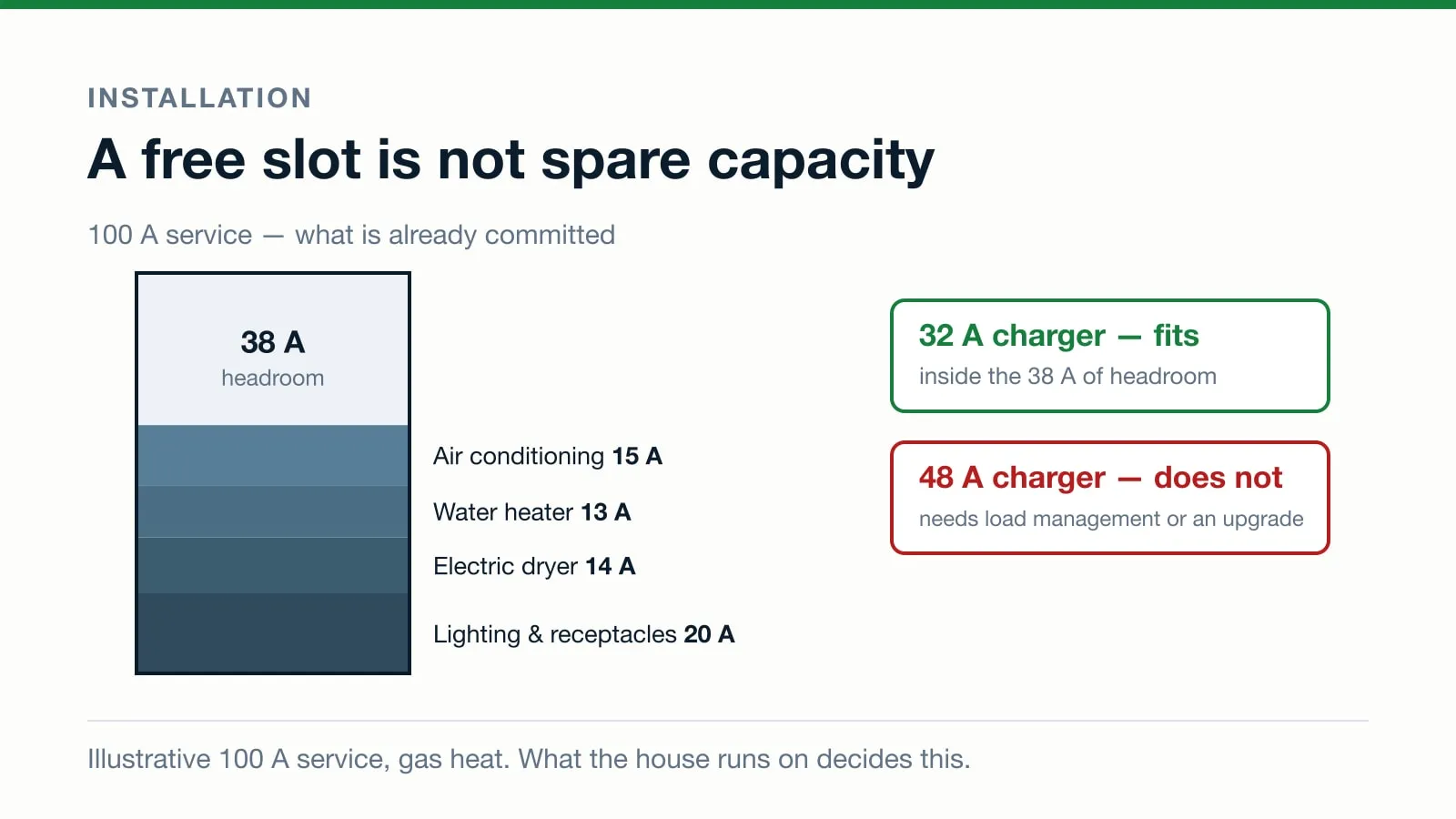
An empty breaker slot is not spare capacity.
A slot is physical room in the enclosure. Capacity is how much current the service conductors and the main breaker can carry. The two have nothing to do with each other.
A packed panel on a 200 A service may have plenty of capacity — tandem breakers or a small subpanel solve the space problem for a few hundred dollars. A panel with six empty slots on a 100 A service feeding electric heat may have none at all.
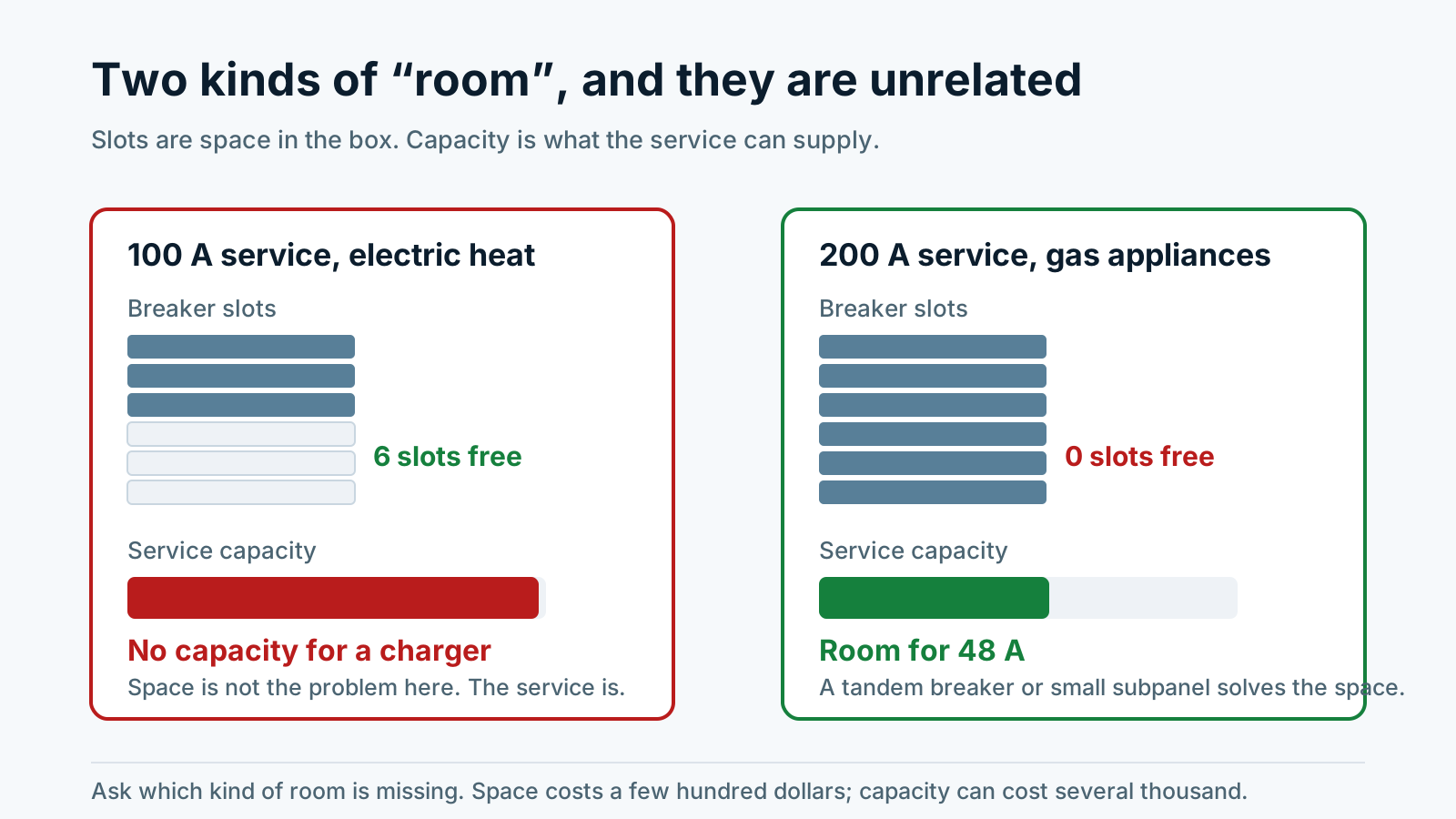
When an electrician says “you don’t have room”, ask which kind of room they mean. It changes the price by an order of magnitude.
What the calculation actually does
The code method adds up what the house can demand, applies diversity factors — because not everything runs at once — and compares the total against the service rating.
The rough version you can do at the kitchen table:
- Find your service rating. It is stamped on the main breaker at the top of the panel — 100, 150 or 200 A.
- List the big electric loads. Range, dryer, water heater, air conditioning, electric heat, hot tub, well pump.
- Anything on that list running on gas does not count. This is usually what decides the outcome.
- Compare what remains against the service.
That is not the code calculation and you cannot pull a permit with it. It tells you, within a few minutes, whether you are likely to be having an easy conversation or an expensive one.
The pattern that actually predicts the answer
Across the invoices and quotes we see, the deciding variable is almost never the service size on its own. It is how much of the house is electric.
| House | 100 A service | 200 A service |
|---|---|---|
| Gas heat, gas range, gas water heater | 32 A usually fits | 48 A usually fits |
| Gas heat, electric range and dryer | 32 A often fits | 48 A usually fits |
| Electric heat or heat pump, electric range | rarely fits without help | 32–48 A usually fits |
| Above plus a second EV | needs load management or an upgrade | often needs load management |
A 100 A service in a gas-heated house is not the problem people assume. A 200 A service in an all-electric house with a heat pump is more constrained than its number suggests.
When the answer is no, this is the cheap way out
Here is the option that is skipped in most quotes, and it is the single largest saving available on the whole project.
Load management. A device monitors what the house is drawing and throttles or pauses the charger when demand rises. The total never exceeds the service, so the calculation passes without touching the utility connection at all.
Load management vs a service upgrade
Pros
- A few hundred dollars installed, against $1,500–$3,500 for 100 A to 200 A
- No utility coordination, no meter swap, no waiting weeks for scheduling
- Compliant products are accepted by most inspecting authorities
- The charger still delivers full power the great majority of the time
Cons
- Charging slows briefly when the oven, dryer and air conditioning coincide
- One more networked device in the chain that can fail
- Does not add headroom for a heat pump or a second EV later
- A few jurisdictions and a few utilities are still awkward about it
The honest case for upgrading anyway: if a heat pump, an induction range or a second EV is genuinely coming in the next few years, doing the service once is cheaper than doing it in stages. If none of that is planned, load management is usually the better spend.
The other cheap answer: ask for less
The calculation is not only about the house. It is about the charger you asked for.
Almost every Level 2 unit has a configurable current limit, so a 48 A charger is usually a 48/40/32/24/16 A charger. Dropping from 48 A to 32 A removes 20 A from the calculation, and it very often turns a failing calculation into a passing one.
What it costs you is about six miles of range per hour — invisible across a twelve-hour night unless you routinely drive more than 200 miles in a day. Before you spend money to pass the calculation at 48 A, check whether you need 48 A: 32 amps vs 48 amps puts real numbers on what each restores overnight.
This is worth raising explicitly, because a quote built around the charger you named will not suggest it for you.
What to ask, and what a good answer sounds like
Three questions. The answers tell you whether the calculation was done or assumed.
- “What did the load calculation come out to?” A real answer is a number in amps, and a comparison against your service rating. “It’ll be fine” is not a calculation.
- “Is the constraint capacity or physical space?” Different problems, different prices.
- “Would load management avoid the upgrade here?” If the answer is no, ask why — there are legitimate reasons, and they should be specific to your house.
An electrician who answers all three without hesitating is worth paying more for. One who quotes a service upgrade over the phone, without having seen your panel or asked what your heating runs on, is guessing — and the guess is expensive in one direction only.
The bottom line
Check what your heating, range and water heater run on before you worry about the number on your main breaker. Gas appliances are what create headroom, and a 100 A gas-heated house is a far easier candidate than a 200 A all-electric one.
If the calculation fails, ask about load management and about configuring the charger down before you accept a service upgrade. Between them they resolve most failing calculations for a few hundred dollars.
And have the calculation done properly by the electrician who will pull the permit. The kitchen-table version above is for knowing what to expect, not for signing off on.
Frequently asked questions
Can a 100 A panel support an EV charger?
Very often yes. A 100 A service with gas heating, a gas range and a gas water heater usually has room for a 32 A charger. The same service with electric heat, an electric range and an electric dryer frequently does not. The appliances decide it, not the number on the main breaker.
Does a free breaker slot mean I have capacity?
No, and this is the most common misunderstanding. A slot is physical space in the enclosure. Capacity is how much current the service can supply. They are unrelated, and a panel can be physically full while having capacity, or have empty slots and none.
How do I find out my service size?
Read the amperage stamped on the main breaker at the top of the panel — typically 100, 150 or 200 A. That is the service rating. It is the input to the calculation, not the answer to it.
What is load management, and will it pass inspection?
A device that monitors household consumption and throttles or pauses the charger when the house draws heavily, so the total never exceeds the service. Products compliant with the relevant code article are accepted by most inspectors, and they cost a few hundred dollars against $1,500–$3,500 for a service upgrade.
How much does a panel upgrade cost?
Typically $1,500 to $3,500 for 100 A to 200 A, and it involves the utility, a meter swap and scheduling that can run to weeks. It is the single largest avoidable cost in a home charger installation.
Can I do the load calculation myself?
You can do a rough version to know what to expect, and this article shows how. You cannot use it to pull a permit — the calculation on the permit has to come from the licensed electrician doing the work, because they carry the liability for it.