32-Amp vs 48-Amp Home EV Charging: When the Bigger Charger Changes Nothing
A 48-amp charger delivers 50% more power than a 32-amp unit. Most cars and most homes cannot use the difference. What actually decides your charging speed.
A 48-amp home charger can deliver 50% more power than a 32-amp unit. That does not mean your car will charge 50% faster, and it rarely means you will leave home with more range.
Three limits decide the real speed: the circuit, the wall equipment and the vehicle’s onboard charger. The lowest of the three wins.
The numbers first
At a nominal 240 volts:
| Charging output | Power | Typical dedicated circuit | Energy in 8 hours |
|---|---|---|---|
| 16 A | 3.8 kW | 20 A | 30.7 kWh |
| 24 A | 5.8 kW | 30 A | 46.1 kWh |
| 32 A | 7.7 kW | 40 A | 61.4 kWh |
| 40 A | 9.6 kW | 50 A | 76.8 kWh |
| 48 A | 11.5 kW | 60 A | 92.2 kWh |
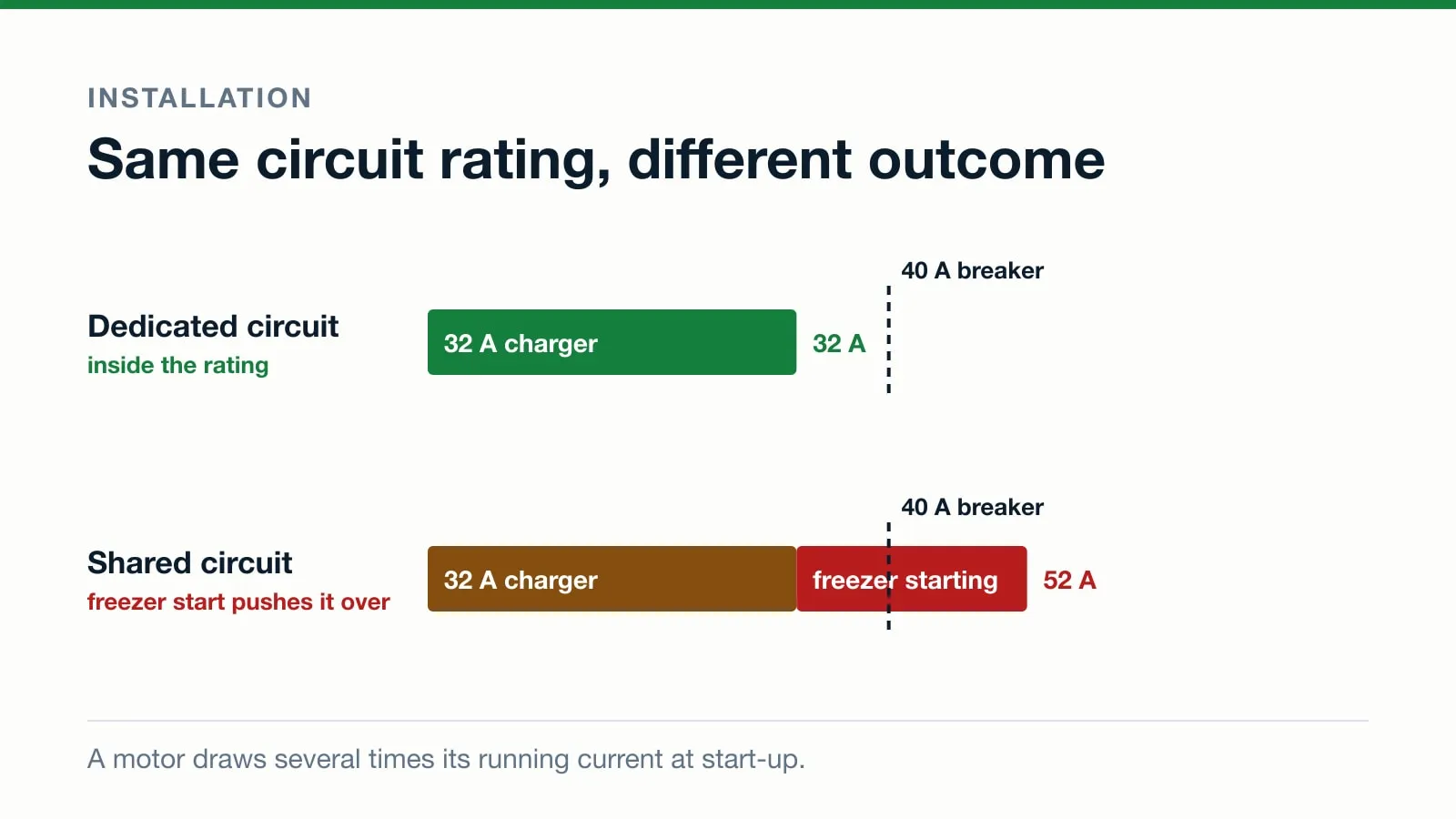
Each circuit is rated 25% above the charging output because EV charging is a continuous load — one expected to run at full power for three hours or more. US practice limits a continuous load to 80% of the circuit rating, which is where the 32-on-40 and 48-on-60 pairings come from. Circuit design depends on the equipment listing, the installation method and your local authority, so this is the reasoning, not a specification for your house.
Energy figures are measured at the wall, before vehicle losses and before any taper the car applies as the battery fills.
The car decides how much it accepts
The box on the wall is not the charger in the strict sense. It is supply equipment: it tells the car how much current is available and connects it safely. The onboard charger inside the car converts AC to DC for the battery, and its rating is a fixed property of the vehicle.
If a car’s onboard charger is limited to 7.7 kW, plugging it into an 11.5 kW wall unit produces about 7.7 kW. The extra capacity does nothing.
Onboard AC ratings vary by model, and often by trim within the same model — entry-level and rear-wheel-drive versions are frequently the ones limited to around 7.7 kW. Before you choose a circuit, look up your vehicle’s maximum AC charging rate in its own documentation — or start from the published figure in the car-by-car guides, which work through what each model’s ceiling means for the circuit behind it.
One trap worth naming: do not use the car’s DC fast-charging figure. A car advertising 250 kW fast charging may still accept only 7.7 kW at home. They are different systems on different pins, and the large number is the one that gets printed on the brochure.
What 32 amps actually restores overnight
Power is abstract. Range per night is the comparison that decides anything.
Assuming 240 V, an eight-hour connection and 88% delivery efficiency:
| Vehicle efficiency | 32 A / 7.7 kW | 48 A / 11.5 kW |
|---|---|---|
| 2.5 mi/kWh (large truck or SUV) | 135 miles | 203 miles |
| 3.0 mi/kWh (mid-size crossover) | 162 miles | 243 miles |
| 3.5 mi/kWh (typical sedan) | 189 miles | 284 miles |
| 4.0 mi/kWh (efficient compact) | 216 miles | 324 miles |
View as table
| Item | miles of range |
|---|---|
| 48 A / 11.5 kW — if the car accepts it | 284 mi |
| 32 A / 7.7 kW | 189 mi |
| A 100-mile day — a long commute | 100 mi |
| A 50-mile day — a common one | 50 mi |
The two reference bars are what a driver actually uses in a day. Both installations clear both of them before morning — which is the reason the gap between the first two bars matters less than it looks.
Source: HomeEnergyX calculation at 240 V nominal, 88% delivery efficiency, eight hours connected, no vehicle taper.
The 48-amp installation restores about 95 additional miles in that window. But a driver covering 50 miles a day is finished on either system long before morning. The faster unit changes what time charging completes, not the range available at departure.
That is the distinction the whole decision turns on. Faster is not the same as more.
Which output earns its installation cost
Pros
- The car genuinely accepts around 11.5 kW AC — check, do not assume
- You arrive late at a low state of charge and leave again a few hours later
- A large, inefficient truck or SUV has to recover serious range overnight
- Two drivers share one charging position and need quick turnover
- The panel already has the capacity, and the conductor run is short
Cons
- Daily driving is under roughly 100 miles and the car sits all night
- The vehicle itself is capped near 7.7 kW AC
- The panel has little spare capacity on a load calculation
- Going bigger would trigger a service upgrade, a longer run or a panel change
- A load-management device would meet the same need for less money
The cost is behind the wall, not on the box
Many 32-amp and 48-amp wall units cost within a few tens of dollars of each other. The real difference is the circuit feeding them.
Going from a 40-amp circuit to a 60-amp one can mean heavier conductors, a different breaker, hardwiring instead of a receptacle, harder conduit work — and occasionally changes elsewhere in the electrical system. How much of that applies depends on distance, routing, local code and what the panel has left.
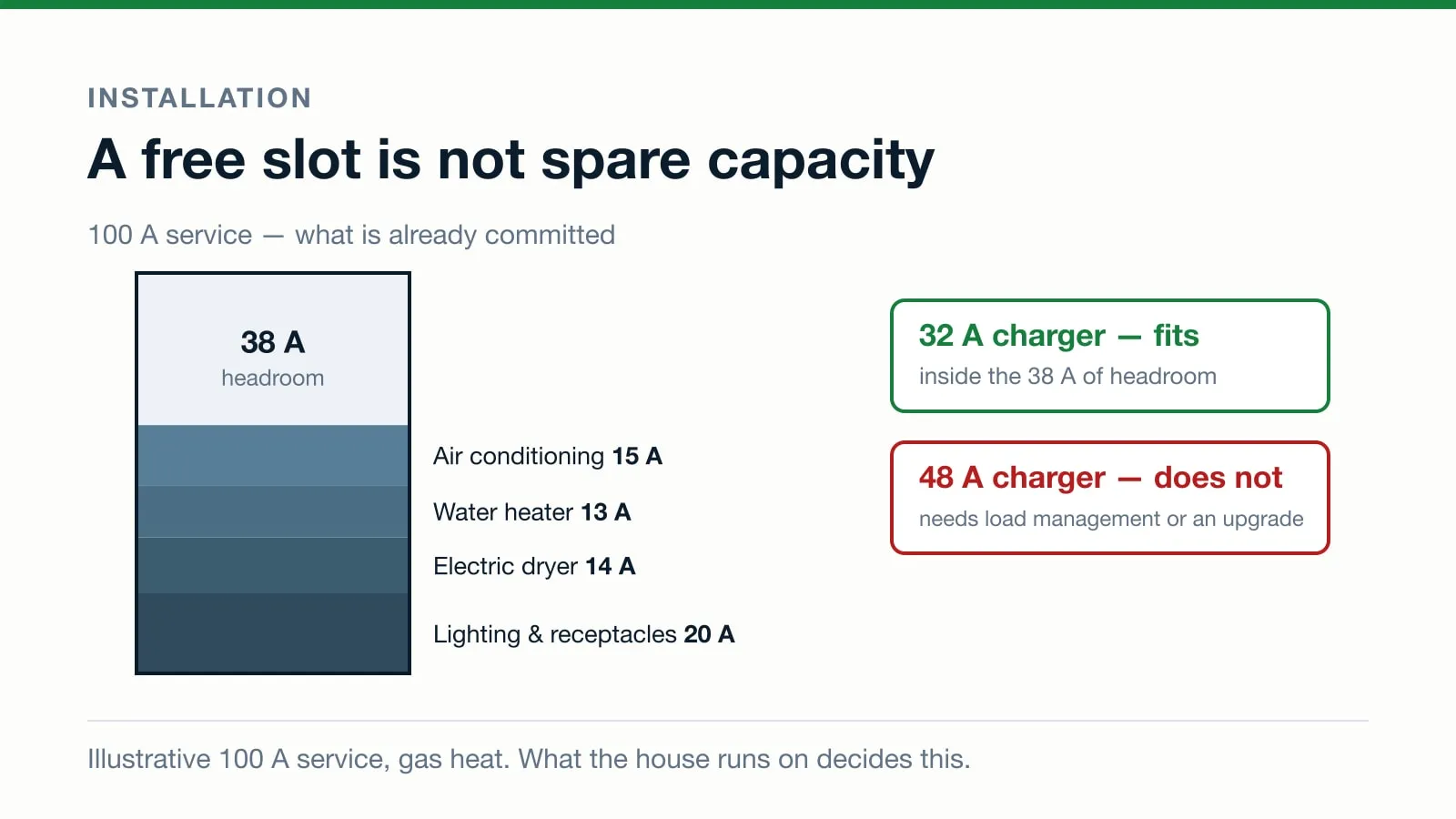
A free breaker slot is not spare capacity. Physical space in the panel and available electrical load are different questions, and only a load calculation answers the second. That calculation is an electrician’s job, and it is the step that decides this whole purchase.
Where capacity is genuinely tight, dynamic load management is worth raising before a service upgrade. These systems watch total household demand and throttle the car when other large loads run, which often buys useful charging power for a fraction of the cost of upgrading the service.
How long a session takes
Assume 60 kWh has to be delivered from the wall and the car accepts full output throughout:
| Output | Time for 60 kWh |
|---|---|
| 16 A / 3.8 kW | 15 h 38 min |
| 24 A / 5.8 kW | 10 h 25 min |
| 32 A / 7.7 kW | 7 h 49 min |
| 40 A / 9.6 kW | 6 h 15 min |
| 48 A / 11.5 kW | 5 h 13 min |
Real sessions run longer because of losses, thermal management and the taper most cars apply as the battery fills. Use this to compare power levels, not to predict a departure time.
Between 32 and 48 amps the difference here is 2 hours 36 minutes — spent, for most people, asleep.
A better way to size it
Start from the energy you actually use, not from the largest unit available.
- Divide your daily miles by your car’s real-world mi/kWh.
- Add roughly 12% for charging losses.
- Divide by the hours the car is normally plugged in.
- Check the car’s maximum AC input — that caps everything above.
- Have an electrician determine what the house can supply safely.
Worked example. Fifty miles a day at 3.5 mi/kWh needs about 14.3 kWh in the battery. At 88% delivery that is about 16.2 kWh at the wall. Spread over an eight-hour night, the average power required is about 2.0 kW — less than a third of what a 32-amp circuit provides, and under a fifth of a 48-amp one.
That is not an argument for installing the smallest circuit possible. Reserve capacity is genuinely useful for unusual days, cold weather and the next car. It is an argument that 48 amps should answer a measured need rather than be the default.
The Department of Energy makes a related point that rarely survives into buying advice: many owners meet their daily range needs charging overnight on Level 1 alone, with no installation at all. Level 2 exists for longer commutes, irregular schedules and large batteries — not as a universal requirement.
The bottom line
A 48-amp charger is faster only when the car accepts the extra power. Even then, faster does not automatically mean more useful.
At 240 volts, 32 amps gives about 7.7 kW and can put more than 60 kWh into a car overnight — comfortably past what most drivers use in a day. Forty-eight amps raises the ceiling to about 11.5 kW, and earns that for compatible vehicles with high mileage, big batteries or short charging windows.
Check the car first, calculate the energy you actually have to replace, and price the complete installation rather than the box. The right home charger is the smallest system that reliably restores your range before you leave, with sensible allowance for what comes next.
Frequently asked questions
Is a 48-amp EV charger 50% faster than a 32-amp charger?
Its maximum power is 50% higher at the same voltage — about 11.5 kW instead of 7.7 kW at 240 V. The car only charges that much faster if its onboard AC charger accepts 48 amps. If the car is limited to 7.7 kW, the larger unit delivers 7.7 kW.
What circuit is normally used for a 32-amp EV charger?
In typical US installations, a 32-amp continuous output sits on a 40-amp dedicated circuit — 32 being 80% of 40. The actual design must follow the equipment instructions, the applicable code and the local authority.
What circuit is normally used for a 48-amp EV charger?
A 48-amp continuous output is commonly installed on a 60-amp dedicated circuit and is generally hardwired rather than plugged in. A qualified electrician must verify conductor sizing, panel capacity and local requirements.
Will a 48-amp wall charger make a 32-amp vehicle charge faster?
No. A vehicle whose onboard charger is limited to 32 amps draws no more than about 32 amps regardless of how much current the wall unit offers. The extra capacity sits unused.
Is 32 amps enough for home charging?
For most drivers, yes. At 240 V it provides about 7.7 kW, which restores roughly 189 miles in an eight-hour night for a car doing 3.5 mi/kWh — far more than a typical day's driving. Check your daily mileage, your parking window and your car's AC limit before assuming you need more.
Should I install 48 amps for a future EV?
It is reasonable when the extra installation cost is small and the service already has capacity. If it forces a panel or service upgrade, a 32-amp circuit or a load-management device usually gives better value until a future vehicle creates a real need.
Sources
- U.S. Department of Energy, Alternative Fuels Data Center, Charging Electric Vehicles at Home — Level 2 operating at 240 V, and the finding that many owners meet their daily range needs charging overnight on Level 1Accessed 15 August 2026.
- National Fire Protection Association, NFPA 70, National Electrical Code — continuous-load and electric-vehicle supply equipment provisions — Basis for treating EV charging as a continuous load, hence the 80% limit. The adopted edition and any local amendments vary by jurisdictionData: 2023 edition and later. Accessed 15 August 2026.
- HomeEnergyX, How we calculate — The 88% charging efficiency assumption, the 240 V nominal figure and the rounding used in every table belowAccessed 15 August 2026.