Hyundai Ioniq 5 Home Charging: The Circuit That Matches the Car
The Ioniq 5's onboard charger tops out at 10.9 kW, so a 60 A circuit is the last one that buys anything. What each option restores overnight, and why 800 V changes nothing at home.
The Ioniq 5 has a reputation for charging faster than almost anything at its price, and that reputation is entirely earned — at a DC fast charger. At home it is an ordinary car, and treating it as an exceptional one is how people end up paying for a circuit it will never use.
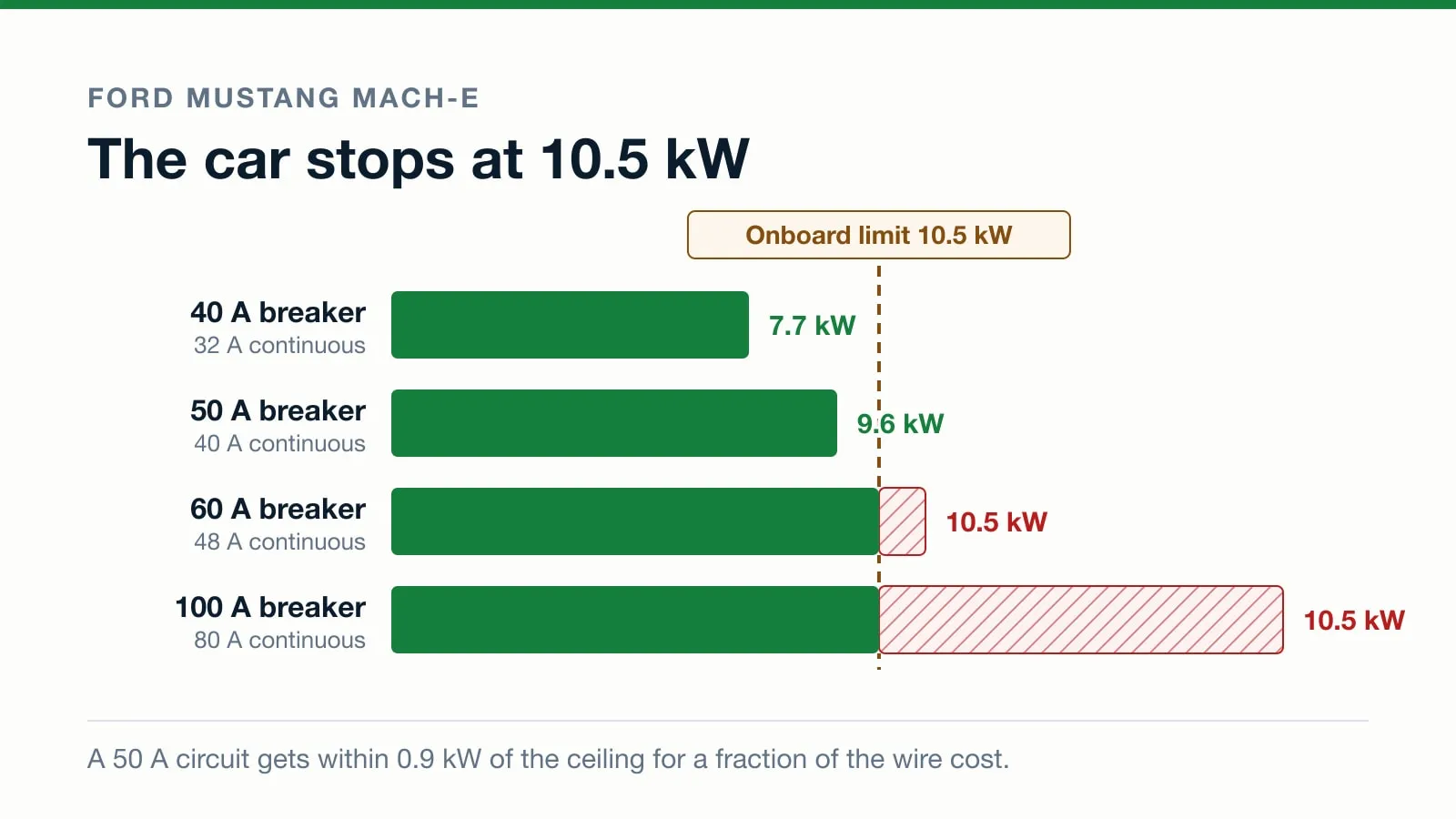
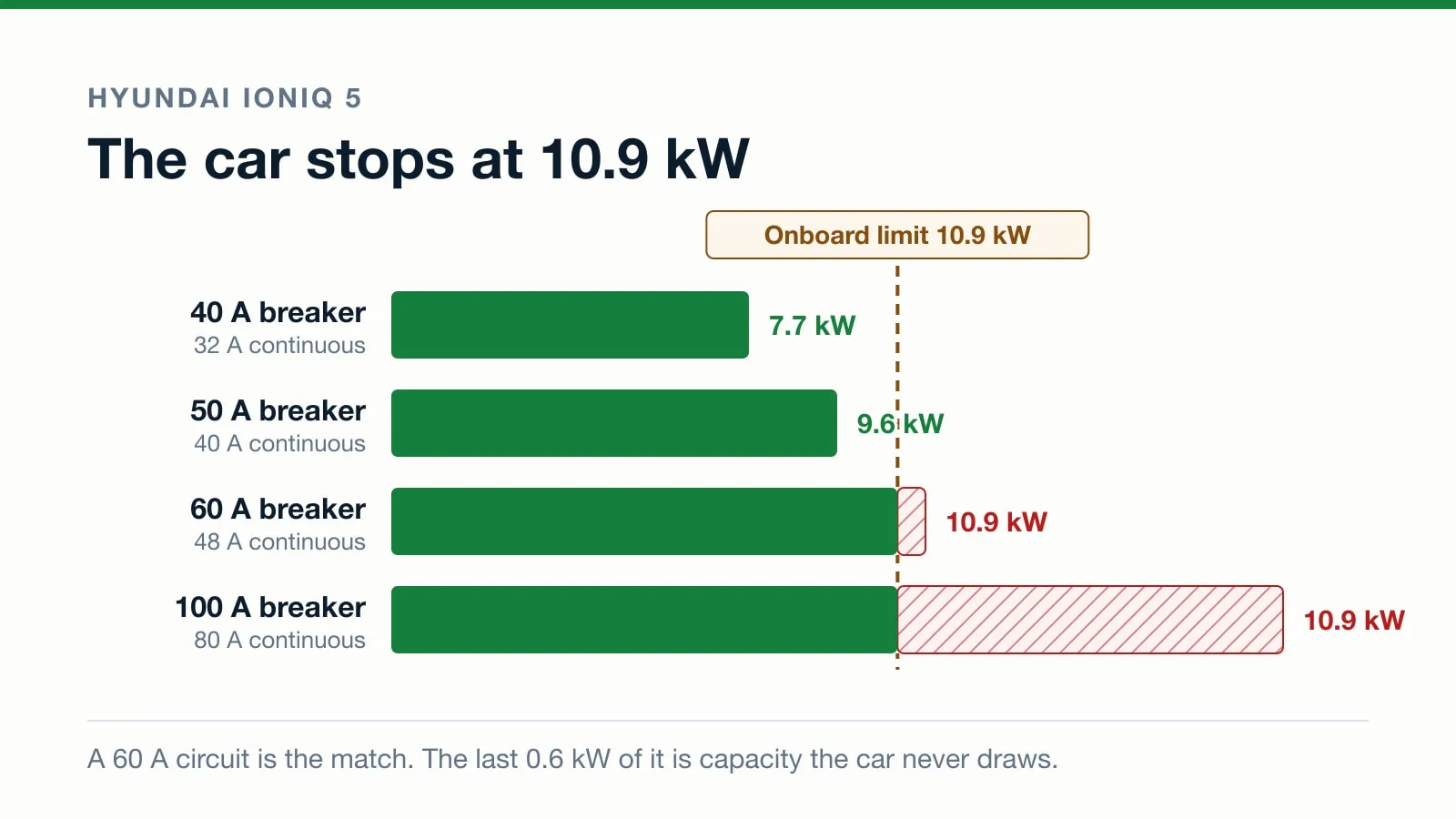
The onboard AC charger stops at 10.9 kW. That is the number the whole installation should be sized around.
The 800 V confusion, cleared up first
The Ioniq 5 runs an 800 volt battery architecture, which is why it can take around 235 kW at a suitable DC fast charger and go from 10% to 80% in roughly eighteen minutes.
None of that applies at home. AC charging goes through the onboard charger, a separate converter that turns wall AC into DC for the pack, and its ceiling is 10.9 kW no matter what the pack voltage is.
So the car that outruns a Model 3 at a fast charger charges slightly slower than one at home. Both facts are true and they are about different hardware.
What each circuit gives you overnight
At roughly 3.2 miles per kWh, which is a realistic all-season figure for an Ioniq 5 rather than an EPA best case:
| Circuit | Continuous | Power the car draws | Miles per hour | Added in 10 hours |
|---|---|---|---|---|
| 20 A | 16 A | 3.8 kW | ~12 | ~120 |
| 40 A | 32 A | 7.7 kW | ~25 | ~245 |
| 50 A | 40 A | 9.6 kW | ~31 | ~305 |
| 60 A | 48 A | 10.9 kW | ~35 | ~350 |
| 100 A | 80 A | 10.9 kW | ~35 | ~350 |
Two things worth reading twice. The last two rows are identical, because the car is the constraint. And the 60 A row delivers 10.9 kW, not the 11.5 kW the circuit is capable of — the last 0.6 kW is capacity the car simply never draws.
Which circuit to actually install
A 40 A circuit covers most Ioniq 5 owners. About 245 miles restored over a ten-hour night, against a median daily drive of under 40 miles.
A 60 A circuit earns its cost if you drive long distances regularly, the car is shared, or your pack is the 77.4 kWh Long Range and you want the 10–80% window comfortably inside a shorter night.
The car does not care beyond that. What decides the price is whether your panel has the capacity and how far the run is from the panel to the parking space.
60 A vs 40 A for an Ioniq 5
Pros
- Uses the car’s full 10.9 kW, restoring roughly 105 more miles over a night
- 10–80% on the Long Range pack drops from about 8 hours to under 6
- Headroom for a future EV with a higher onboard limit
- Shorter turnaround when the car comes home nearly empty
Cons
- Heavier conductor and a 60 A breaker, more so on a long run
- More panel capacity required, which is where service upgrades start
- 0.6 kW of the circuit is capacity this car will never draw
- Invisible on a typical commute, where both options wake up full
The circuit behind the number
Charging runs for hours, which makes it a continuous load, and continuous loads are sized at 125% of their current. 48 A becomes a 60 A breaker; 32 A becomes a 40 A breaker. It is the same rule for every EV circuit, and it is why a 48 A charger cannot legally sit on a 50 A circuit.
Conductor size then starts from the breaker and grows with distance — voltage drop is what makes a long run expensive, not the amperage on its own.
Connector, and the V2L question
North American Ioniq 5s built through the 2024 model year use J1772 for AC charging; later cars have moved to NACS, and Hyundai supplies an adapter either way. At home the distinction changes nothing about speed — both carry the same 48 A over the same conductors.
Vehicle-to-load is the feature worth understanding properly, because it gets confused with home backup. The V2L adapter plugs into the car and gives you a regular outlet delivering up to about 1.9 kW. It runs tools, a fridge, or a campsite. It needs nothing from your house wiring.
What it is not is vehicle-to-home backup. Powering your house from the car requires a transfer switch and a considerably larger installation, and the Ioniq 5’s V2L adapter does not provide it.
The bottom line
Size the install to 10.9 kW, because that is where the car stops. A 60 A circuit reaches it; a 100 A circuit reaches it no faster and costs several times more.
If your driving is ordinary, a 40 A circuit fills the car overnight and leaves the difference in your pocket. And do not let the 800 V architecture push you towards a bigger circuit than the onboard charger can use — that speed lives at the fast charger, not in your garage.
Frequently asked questions
What size circuit does a Hyundai Ioniq 5 need?
A 60 A breaker at 48 A continuous, which lets the car draw its full 10.9 kW. A 40 A breaker delivers 7.7 kW and is a perfectly workable cheaper option — the difference is about 25 miles over a ten-hour night.
How many kW can an Ioniq 5 accept on AC?
10.9 kW, drawn as 48 A at 240 V. That is the onboard charger's ceiling and no wall box can exceed it, however it is rated.
Does the Ioniq 5's 800 V system make home charging faster?
No. The 800 V architecture is what makes it exceptional at DC fast charging. AC charging at home goes through the onboard charger, which is limited to 10.9 kW regardless of the pack voltage.
How long does an Ioniq 5 take to charge at home?
A Long Range car with a 77.4 kWh pack takes roughly 5.5 to 6 hours from 10% to 80% on a 60 A circuit, and around 8 hours on a 40 A circuit. Both fit comfortably inside a night.
Is an 80 A charger worth it for an Ioniq 5?
No. The car stops at 48 A, so an 80 A unit and the 100 A circuit it requires charge no faster than a 60 A circuit while costing considerably more to install.
Does vehicle-to-load charging need special wiring?
The V2L adapter draws from the car's own outlet and needs nothing from your house. True vehicle-to-home backup is a different, larger installation with a transfer switch, and is not what V2L provides.
Sources
- Hyundai, Ioniq 5 charging specifications — Onboard AC charger rating for North American models. European three-phase variants differ and are not covered here.Accessed 16 August 2026.
- Recharged, Hyundai Ioniq 5 charging speed guide — Cross-check on the 10.9 kW figure and on 10–80% timings by pack size.Accessed 16 August 2026.