Tesla Model Y Home Charging: What Circuit It Actually Needs
The Model Y's onboard charger stops at 11.5 kW, which makes a 60 A circuit the ceiling worth paying for. Here is what each circuit restores overnight and where the extra spend stops buying miles.
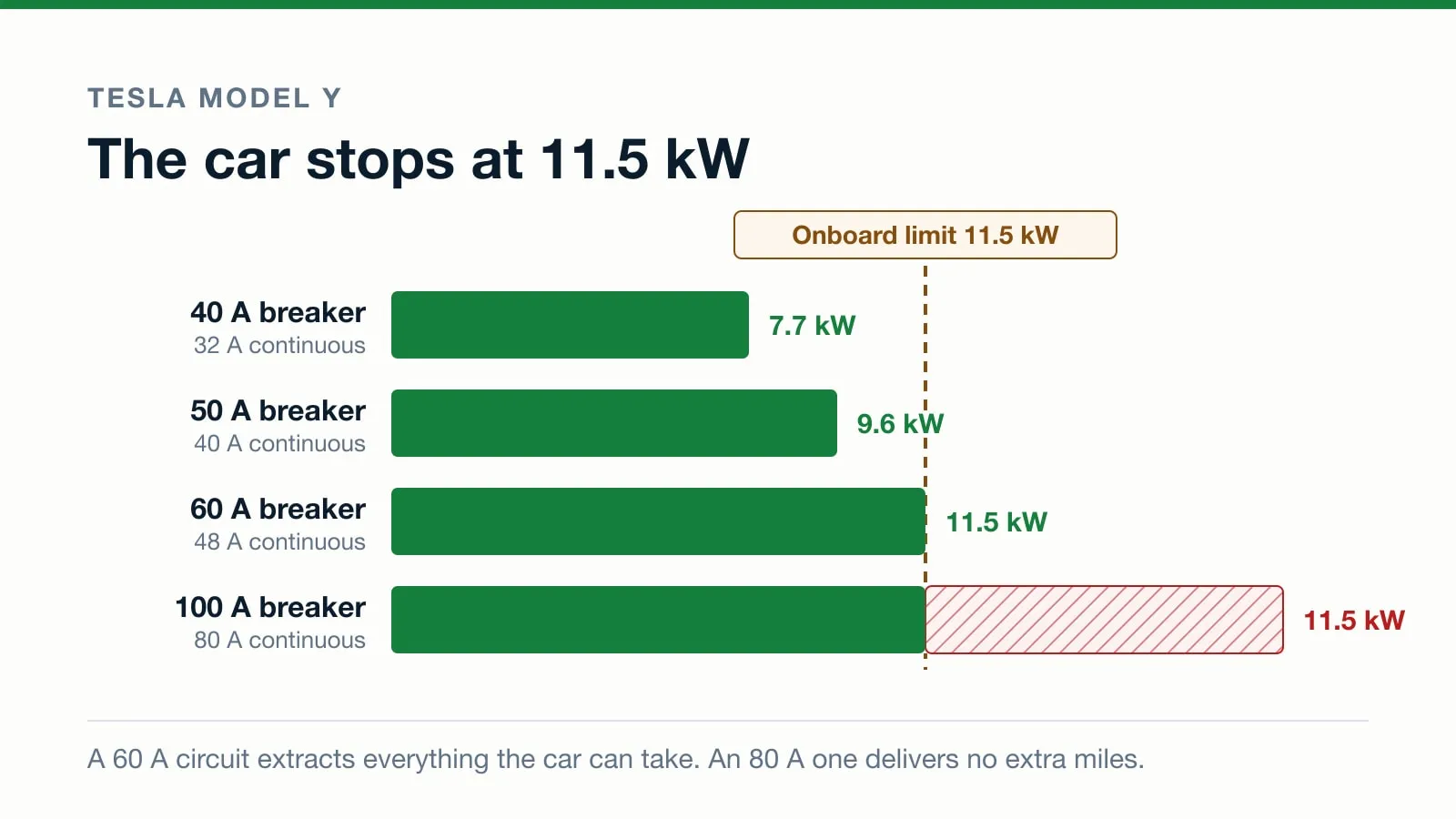
The Model Y is the most common car a home charger gets installed for, and it is also the one most often over-specified. The reason is a single number that does not appear in any quote: the car’s onboard charger stops at 11.5 kW.
Everything above that is capacity you pay to install and the car declines to use.
The number that decides it
The onboard charger is the converter inside the car that turns AC from your wall into DC for the battery. It has a fixed ceiling, and no wall box can push past it.
| Model Y variant | Onboard AC limit | Amps at 240 V |
|---|---|---|
| Long Range / Performance / AWD | 11.5 kW | 48 A |
| Standard Range RWD | 7.7 kW | 32 A |
That second row is the one that catches people. A standard-range rear-wheel -drive car on a 60 A circuit charges at exactly the same speed as it would on a 40 A circuit, because 32 A is all it will draw.
Check your own car before you spend anything. In the Tesla app or on the touchscreen, start a charge and read the maximum amperage the car offers. That figure is the answer for your specific vehicle, and it beats any table.
What each circuit gives you overnight
At roughly 3.6 miles per kWh, which is a realistic year-round average for a Model Y rather than a best case:
| Circuit | Continuous | Power | Miles per hour | Added in 10 hours |
|---|---|---|---|---|
| 20 A | 16 A | 3.8 kW | ~14 | ~140 |
| 40 A | 32 A | 7.7 kW | ~28 | ~280 |
| 50 A | 40 A | 9.6 kW | ~35 | ~345 |
| 60 A | 48 A | 11.5 kW | ~41 | ~410 |
| 100 A | 80 A | 11.5 kW | ~41 | ~410 |
Read the last two rows together. They are identical, because the car is the constraint in both. A 100 A circuit for a Model Y is money spent on conductor, breaker and possibly a service upgrade in exchange for nothing at all.
So which one should you install?
The honest answer depends on a question about your driving, not about your car.
A 40 A circuit is enough for most Model Y owners. It restores about 280 miles over a ten-hour night. The median US driver covers around 37 miles a day. Unless you are routinely emptying the battery, you wake up full either way.
A 60 A circuit is worth it if you regularly drive more than 200 miles in a day, share the car between two drivers, or want the shortest possible top-up before an unplanned trip.
The cost gap is not the wall box — most units are configurable and cost the same. It is the conductor, the breaker, and whether your panel has room. That is where a 60 A install can run several hundred dollars more, and whether your panel has the capacity is the question that decides it.
60 A circuit vs 40 A circuit for a Model Y
Pros
- Restores about 41 miles per hour instead of 28 — roughly 130 more over a night
- Uses the car’s full onboard capacity, so nothing is left on the table
- Useful headroom if a second, faster-charging EV arrives later
- Shorter top-ups before an unplanned long drive
Cons
- Heavier conductor and a 60 A breaker add cost, more so on a long run
- Needs more panel capacity, which is where service upgrades get triggered
- Delivers nothing extra on a standard-range RWD car, which stops at 32 A
- The extra 130 miles a night is invisible if you drive 40 miles a day
The circuit behind the number
Once you have picked the current, the rest is arithmetic the code sets for you.
A charger runs for hours, so it is a continuous load, and continuous loads are sized at 125% of their current. That is where 48 A becomes a 60 A breaker and 32 A becomes a 40 A breaker — the same 1.25 that sizes every EV circuit.
Conductor size starts from that breaker and then grows with distance, because voltage drop compounds over the run. For a 60 A circuit, 6 AWG copper is the usual starting point and it stops being enough sooner than people expect on a long garage-to-panel run.
Wall Connector, or something else?
North American Model Y cars use the NACS connector. Tesla’s Wall Connector carries it natively; every other Level 2 charger uses J1772 and works through the adapter that came with the car.
Neither is faster. Both deliver the same 48 A over the same conductors, and the car’s onboard charger is the ceiling in either case. Choose on warranty, cable length, whether you want a plug or a hardwired unit, and whether a second non-Tesla EV might share it later — a J1772 unit is the more flexible of the two in that last case.
One constraint worth knowing before you shop: 48 A means hardwired. A NEMA 14-50 receptacle sits on a 50 A circuit with a 40 A continuous ceiling, so plug-in units cannot reach 48 A. If you want the car’s full rate, the unit has to be hardwired.
The bottom line
Read the maximum amperage off your own car’s charging screen. If it says 48 A, a 60 A circuit is the most you will ever benefit from and an 80 A unit is wasted. If it says 32 A, a 40 A circuit already extracts everything the car can take.
Then decide between 40 A and 60 A on your daily mileage rather than on the badge. Both fill the car overnight for the great majority of drivers, and the cheaper one is a legitimate choice rather than a compromise.
Frequently asked questions
What size circuit does a Tesla Model Y need?
A 60 A breaker, giving 48 A continuous, extracts the full 11.5 kW the Model Y's onboard charger can accept. A 40 A breaker at 32 A continuous delivers 7.7 kW and is the common, cheaper alternative — it restores roughly 28 miles per hour instead of 41.
How many amps can a Model Y accept?
48 A at 240 V, which is 11.5 kW, on most variants. The exception is the standard-range rear-wheel-drive car, which is limited to 32 A and 7.7 kW. Check the charging screen in your own car rather than assuming.
Is an 80 A charger worth it for a Model Y?
No. The car stops drawing at 48 A, so an 80 A wall box and the 100 A circuit it needs deliver exactly the same charging speed as a 60 A circuit, at several times the installation cost.
How long does a Model Y take to charge at home?
From 20% to 80% on a 60 A circuit takes roughly 4 hours on a Long Range car. On a 40 A circuit the same window takes about 6 hours — both of which fit inside an overnight charge.
Do I need a Tesla Wall Connector specifically?
No. Any J1772 Level 2 charger works with the adapter supplied with the car, and North American Model Y cars use the NACS connector the Wall Connector carries natively. Pick on circuit compatibility and warranty, not on the badge.
Can I just use the mobile connector on a normal outlet?
Yes, and for many owners it is enough. A 120 V outlet adds roughly 3 to 4 miles of range per hour, which covers about 40 miles overnight. If you drive less than that on a typical day, you may not need an install at all.
Sources
- Tesla, Onboard Charger — charging support documentation — Tesla publishes the onboard charger rating per model and variant. Figures here are for North American Model Y; other markets differ.Accessed 16 August 2026.
- Tesla Motors Club, Model Y RWD max AC charging speed — Owner reports of the 32 A limit on the standard-range rear-wheel-drive car, which is the variant most often mis-specified in installation quotes.Accessed 16 August 2026.