
What It Actually Costs to Charge an EV at Home in 2026
The national average is 18.44 cents per kWh and rising 6% a year. Here is how that translates into cost per mile, why your bill will differ, and the one setting that halves it.
Most cost-per-charge calculators are wrong in the same two ways: they use a national average that has not been updated in a year, and they quietly assume every kilowatt-hour you buy ends up in the battery. Neither is true.
Here is the arithmetic done properly, with the current number.
The current number
The latest available EIA figure puts the US average residential electricity price at 18.44 cents per kWh, up 6.2% year over year. That is measured data for May 2026, published on 23 July 2026 — the EIA reports retail prices about two months in arrears, so this is the most recent month on record rather than a reading for the month you are in.
Separately, the EIA projects a 2026 annual average near 18 cents, against a measured 17.29 cents in 2025. Every figure below is computed from the measured May 2026 price, not the projection.
That rise matters more than it looks. Electricity has been climbing faster than general inflation for two years, driven by grid investment and demand growth. If you are modelling a payback period over five years, do not hold the rate flat.
Cost per full charge
Take a 75 kWh battery, a common size.
| Usable energy into the battery | 75 kWh |
| Charging losses (AC to battery) | ~12% |
| Energy actually metered | ~85 kWh |
| Cost at 18.44 ¢/kWh | ~$15.70 |
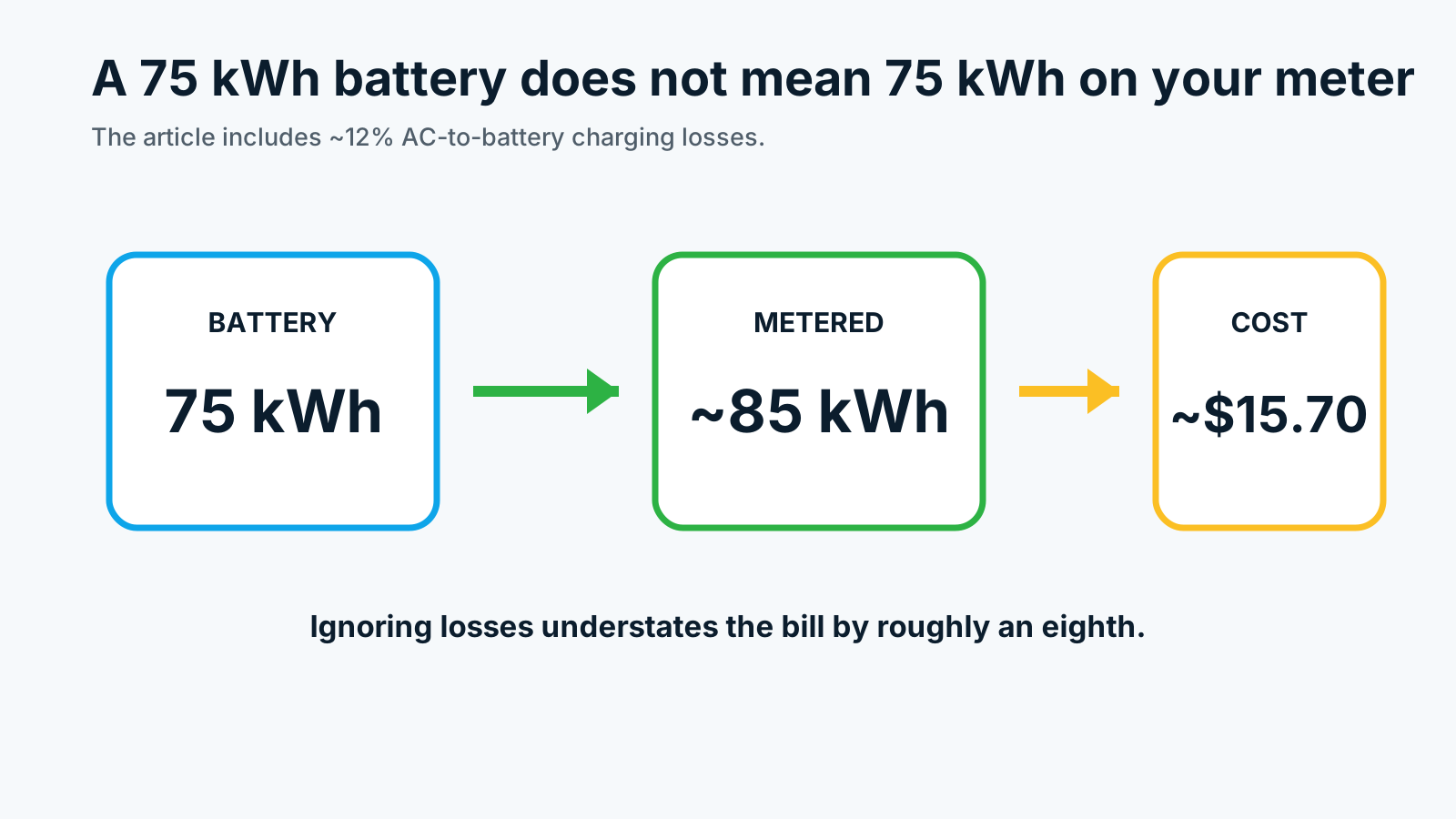
The losses line is the one nearly everyone drops. Power is lost in the onboard charger converting AC to DC, in the cabling, and in battery thermal management — more in cold weather, when the pack has to heat itself before it will accept a charge. Ten to fifteen percent is the normal range. Compute from metered energy or you will understate your bill by about an eighth.
Cost per mile — the number that actually matters
Cost per charge is a bad unit because batteries differ. Cost per mile is comparable across cars, and comparable against petrol.
The formula:
cost per mile = electricity rate ÷ (efficiency × charging efficiency)At 18.44 ¢/kWh and 88% charging efficiency:
| Vehicle efficiency | Cost per mile |
|---|---|
| 2.5 mi/kWh (large truck or SUV) | 8.4 ¢ |
| 3.0 mi/kWh (mid-size crossover) | 7.0 ¢ |
| 3.5 mi/kWh (typical sedan) | 6.0 ¢ |
| 4.0 mi/kWh (efficient compact) | 5.2 ¢ |
| 4.5 mi/kWh (best case, mild weather) | 4.7 ¢ |
View as table
| Item | US cents per mile |
|---|---|
| Petrol, 30 mpg — at $3.20/gal | 10.7 ¢ |
| 2.5 mi/kWh — large truck or SUV | 8.4 ¢ |
| 3.0 mi/kWh — mid-size crossover | 7.0 ¢ |
| 3.5 mi/kWh — typical sedan | 6.0 ¢ |
| 4.0 mi/kWh — efficient compact | 5.2 ¢ |
| 4.5 mi/kWh — best case, mild weather | 4.7 ¢ |
Petrol comparison assumes 30 mpg at $3.20 a gallon. Your figure moves with your tariff, your car and the weather.
Source: HomeEnergyX calculation from the EIA residential average of 18.44 ¢/kWh (May 2026 data, released 23 July 2026), assuming 88% charging efficiency.
For comparison, a petrol car at 30 mpg with fuel at $3.20 a gallon runs about 10.7 cents per mile. So home charging typically saves something like 40-55% per mile — real, but not the 80% figure that gets quoted, which usually comes from comparing cheap off-peak electricity against expensive petrol.
Where the savings are bigger or smaller than average
Pros
- Time-of-use overnight rates, often 6–12 ¢/kWh — roughly halves cost per mile
- Surplus solar, where the marginal cost approaches zero
- Efficient cars in mild climates, comfortably above 4 mi/kWh
- Replacing a truck at 18 mpg rather than a hybrid at 45 mpg
Cons
- Flat rates above 30 ¢/kWh, common in the Northeast, California and Hawaii
- Cold climates, where winter efficiency can drop 25–40%
- Heavy reliance on public DC fast charging, at two to four times home rates
- Charging a large-battery truck daily on a peak-rate tariff
The one setting that changes everything
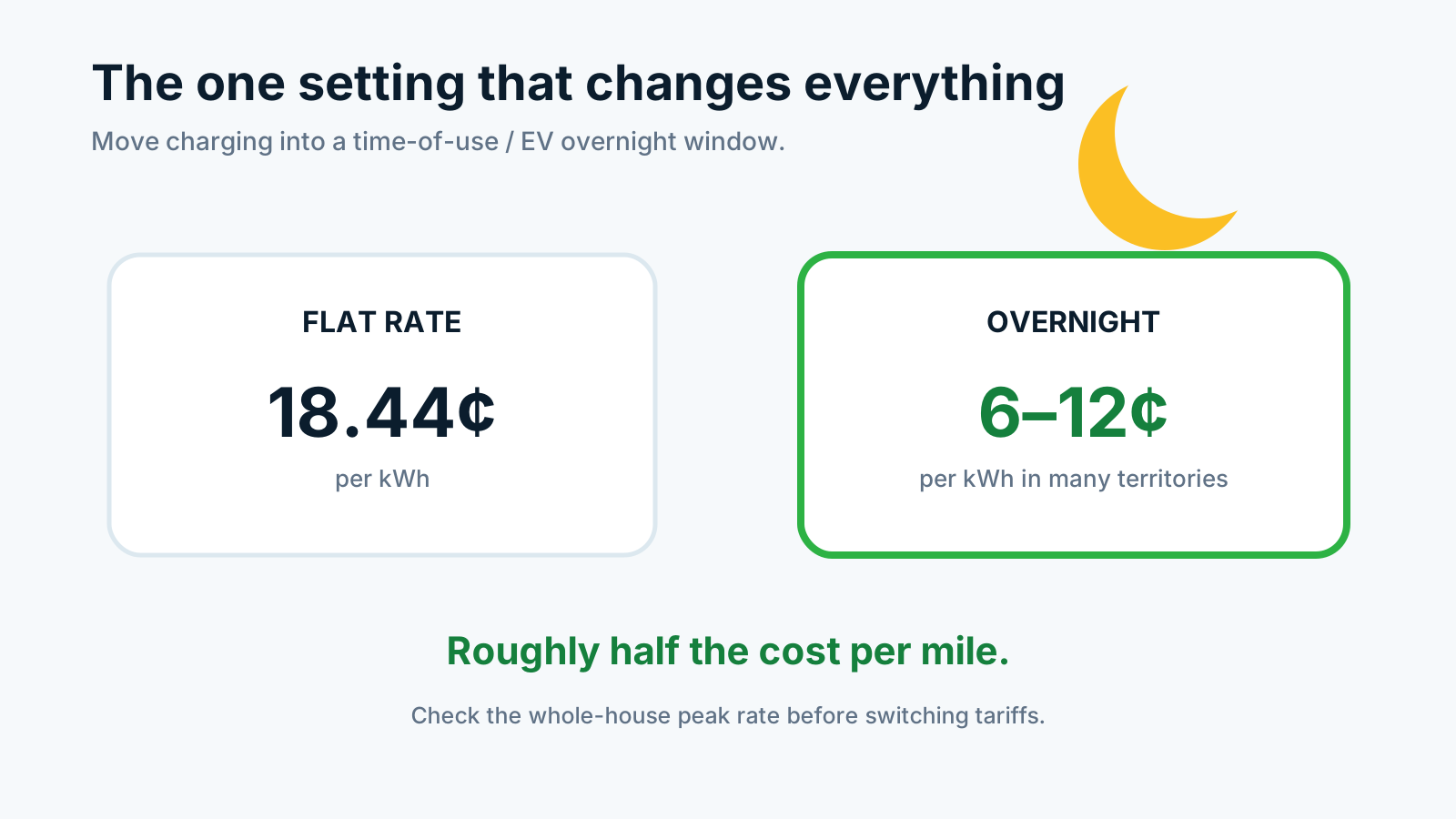
If your utility offers a time-of-use or dedicated EV tariff, moving to it is almost always the single highest-value change available — bigger than which charger you buy, and bigger than most efficiency habits.
The structure is straightforward: electricity costs more during the afternoon and evening peak, and much less overnight. Because a car sits still for eight to twelve hours anyway, an EV is close to the perfect load for this.
Overnight super-off-peak windows in many territories land between 6 and 12 cents per kWh. Against an 18.44 cent flat rate, that is roughly half your cost per mile, for the cost of ten minutes of paperwork and setting a schedule in the car.
Two cautions before you switch:
- The peak rate applies to your whole house. If someone is home all day running air conditioning, the peak penalty on everything else can eat the overnight gain. Utilities publish both rates — do the comparison against your actual usage pattern, not just the charging.
- Set the schedule in the car, not the charger. Cars reliably honour a departure time and a charging window. Chargers vary, and a schedule that silently fails costs you the difference at peak rates.
Monthly bill impact
The question people actually want answered: how much does this add to the bill?
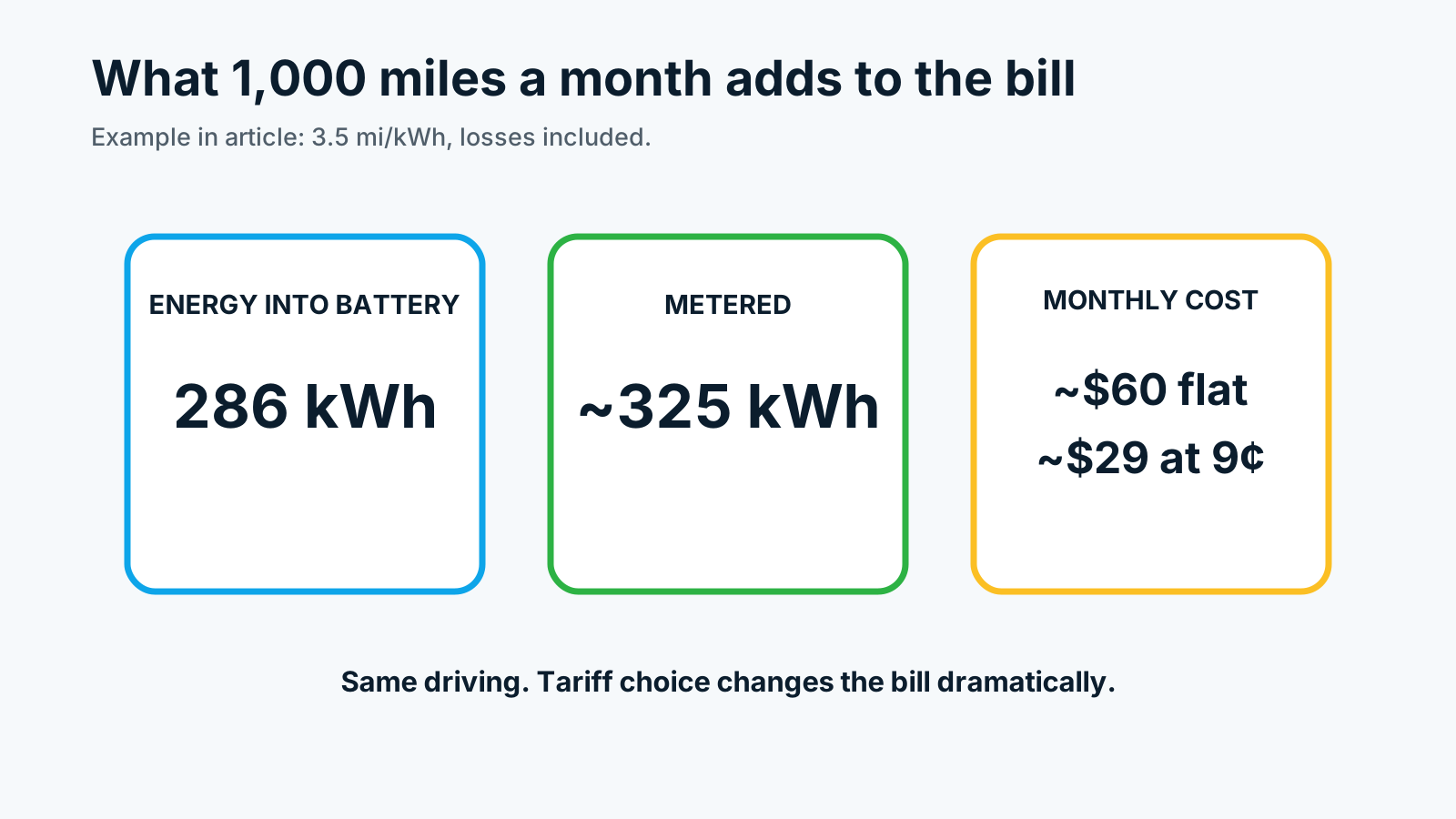
Driving 1,000 miles a month at 3.5 mi/kWh:
- Energy into the battery: 286 kWh
- Metered energy after losses: ~325 kWh
- At 18.44 ¢/kWh: about $60 a month
- On a 9 ¢/kWh overnight rate: about $29 a month
A useful sanity check: if your bill jumps by dramatically more than this, something else is going on — a resistive load you did not account for, a charger left in a high-draw idle state, or a tariff that put you into a higher consumption tier.
Why your number will differ from any published average
Four variables, in rough order of impact:
- Your rate. State averages range from about 11 cents to over 40 cents — and across countries the spread is wider still. The national figure is nearly meaningless for any individual household.
- Your tariff structure. Flat versus time-of-use is often a 2× difference.
- Your climate. Winter efficiency losses of 25-40% are normal, and they compound with the extra energy spent heating the pack before charging.
- Your car. A 2.5 mi/kWh truck costs nearly twice per mile what a 4.5 mi/kWh compact does.
Anyone quoting a single national cost-per-mile figure without naming these is selling something.
The bottom line
At today’s national average, budget 5 to 7 cents per mile for home charging, and roughly $50 to $70 a month for average mileage. Move to an overnight tariff and you can reasonably halve it.
The rate you pay matters far more than the hardware you buy — which is worth remembering before you spend an extra $300 on a charger to save fifteen minutes of charging time you were going to spend asleep anyway. Our Level 1 vs Level 2 guide works through whether you need the faster hardware at all.
Frequently asked questions
How much does it cost to charge an electric car at home?
At the US average of 18.44 cents per kWh — EIA data for May 2026, released 23 July 2026 — a full charge of a 75 kWh battery costs roughly $15 to $16 once charging losses are counted. That works out at about 6 cents per mile for a typical sedan at 3.5 miles per kWh, and 5 to 7 cents per mile across most cars.
Is charging at home cheaper than public fast charging?
Substantially. Home electricity averages about 18 cents per kWh, while public DC fast charging commonly runs two to four times that. The gap is the main reason home charging pays for the installation.
What is a good electricity rate for EV charging?
Anything under about 12 cents per kWh is strong, and many time-of-use overnight windows land there or lower. Above roughly 30 cents, which is common in parts of the Northeast, Hawaii and California, the arithmetic gets much tighter.
How much electricity does an EV add to my monthly bill?
Driving 1,000 miles a month at 3.5 miles per kWh uses about 286 kWh before losses, or roughly 325 kWh after. At 18.44 cents that is about $60 a month.
Do charging losses matter?
Yes, and most calculators ignore them. Roughly 10 to 15% of what your meter records never reaches the battery. Always compute cost from metered energy, not from battery capacity.
Sources
- U.S. Energy Information Administration, Electric Power Monthly, Table 5.3 — Average Price of Electricity to Ultimate Customers by End-Use Sector — Source of the 18.44 ¢/kWh US residential average and the 6.2% year-on-year changeData: May 2026 (released 23 July 2026). Accessed 15 August 2026.
- U.S. Energy Information Administration, Short-Term Energy Outlook — Projection only — the near-18 ¢ annual figure, which is not used in any calculation on this pageData: 2026 annual projection. Accessed 15 August 2026.
- HomeEnergyX, How we calculate — The 88% charging efficiency assumption, the cost-per-mile formula and the rounding rules used aboveAccessed 15 August 2026.