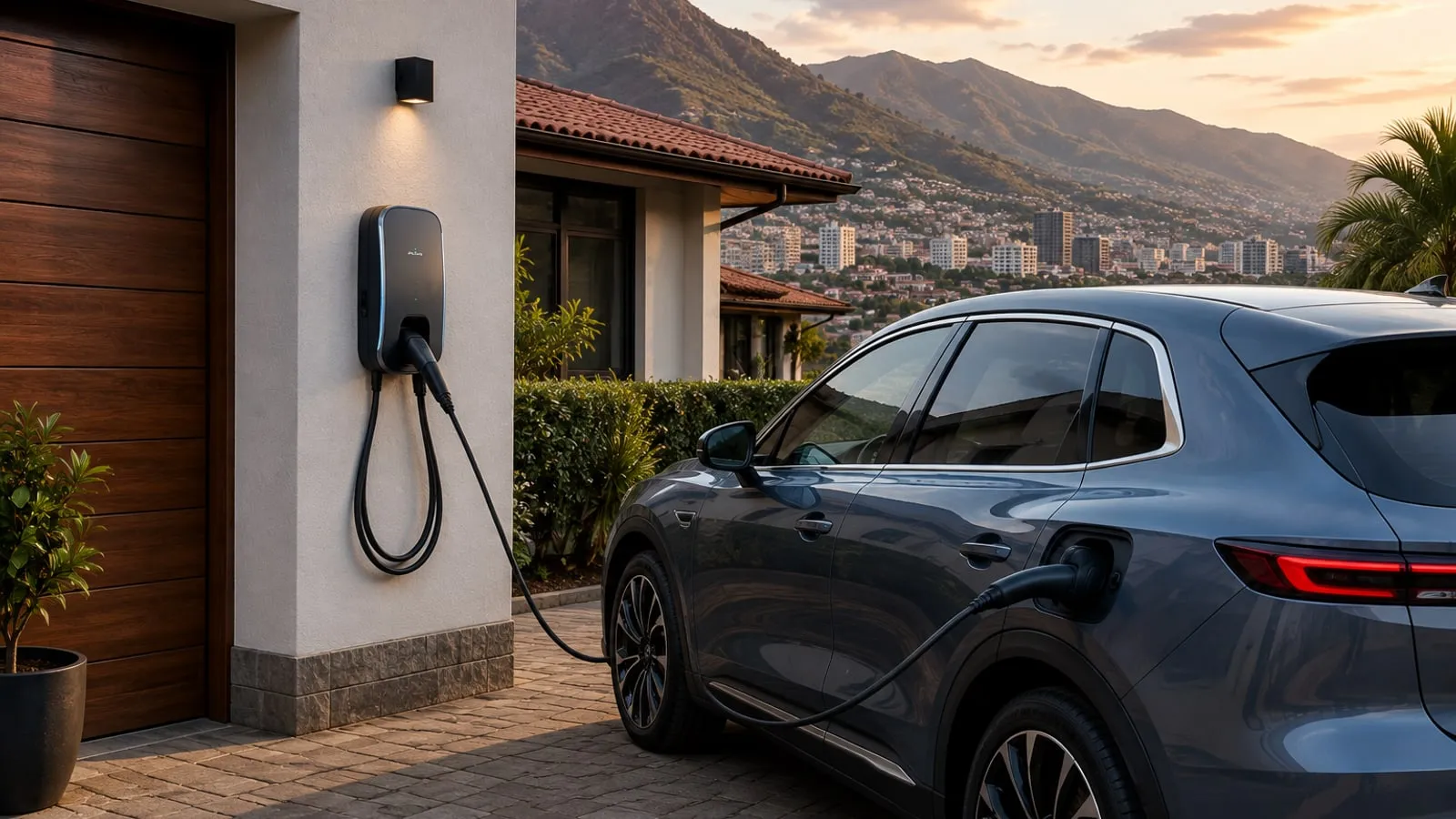
What Home EV Charging Costs Around the World
The same car costs three times more per mile to charge in Germany than in Ecuador. Here is what residential electricity actually costs across the US, Europe and Latin America, and why.
Nearly every guide to home charging is written for one country and quietly assumes its numbers are universal. They are not. The cost of the same kilowatt- hour varies by a factor of four across the markets below, and the hardware standards differ enough that half the advice does not transfer at all.
This is the comparison, with the current figures.
Residential electricity, compared
Converted to US cents for comparability. Exchange rates move, so treat the European figures as approximate in dollar terms and exact in their own currency.
| Market | Residential rate | Notes |
|---|---|---|
| Ecuador | ~10.6 ¢ ($0.1061) | State-subsidised; technical cost is 12.83 ¢ |
| France | ~€0.194 | Regulated EDF Tarif Bleu; alternatives from €0.167 |
| United States | 18.44 ¢ | EIA, May 2026 measured, up 6.2% year on year |
| Spain | ~€0.20–0.40 | Wide range; strongly time-dependent |
| Germany | ~€0.36 | 2026 H1 average; among the highest in Europe |
View as table
| Item | US cents per kWh (approximate) |
|---|---|
| Germany — ≈ €0.36 | ~41 ¢ |
| Spain — €0.20–0.40, time-dependent | ~23–46 ¢ |
| France — €0.194 regulated | ~22 ¢ |
| United States — May 2026, +6.2% YoY | 18.44 ¢ |
| Ecuador — subsidised; 12.83 ¢ true cost | 10.61 ¢ |
Converted to US cents for comparability. Ecuador is dollarised, so its figure needs no conversion.
Source: EIA (US, May 2026 data released 23 July 2026); ARCONEL Ecuador 2026 tariff schedule; published European retail averages, 2026 H1. European figures converted at indicative rates.
The spread is the headline. A German household pays roughly four times what an Ecuadorian household pays for the same energy.
Why the gap is so wide
It is not mainly the cost of generating the electricity.
Taxes, levies and grid fees dominate the retail price in much of Europe. In Germany these components make up a large share of the bill, which is why German retail prices stayed high even as wholesale prices moved.
Subsidy policy works the other way. Ecuador’s regulator set a technical cost of 12.83 ¢/kWh for 2026 against an estimated average billed price of 10.61 ¢ — a gap of 2.22 ¢ per kWh that the state absorbs, worth about $598 million a year. Consumers see a price that does not reflect the cost of supply.
Generation mix matters less than people expect at the retail level. France’s nuclear-heavy mix helps, but its regulated tariff structure does more.
What a low tariff does and does not tell you
Pros
- Directly lowers cost per mile — the dominant running-cost variable
- Improves the payback period on installing a home charger
- Makes overnight charging attractive even without a special tariff
Cons
- A subsidised price can be adjusted by policy, sometimes quickly
- Says nothing about grid reliability, which matters for charging
- The EV case depends on the petrol-to-electricity ratio, not the absolute rate
The ratio that actually decides it
Absolute electricity price is the wrong number to optimise. What determines whether an EV saves money is electricity versus petrol, locally.
Colombia is the clearest example: an EV there costs roughly $85 COP per kilometre in energy against about $550 COP for an equivalent petrol car. That is close to a six-fold gap.
In the US, the same comparison lands nearer 40 to 55% — real, but nothing like six times. High petrol taxes and cheap electricity widen the gap; cheap petrol and heavily taxed electricity narrow it.
So the market where an EV makes the most financial sense is not the one with the cheapest electricity in absolute terms. It is the one with the widest ratio.
Hardware and standards do not transfer
This is where copying advice across borders goes wrong.
| United States & Ecuador | Europe | Chile / Argentina | |
|---|---|---|---|
| Voltage | 120 / 240 V | 230 V single, 400 V three-phase | 220 V |
| Frequency | 60 Hz | 50 Hz | 50 Hz |
| AC connector | J1772 / NACS | Type 2 (Mennekes) | Type 2 |
| Typical home wallbox | 7.7–11.5 kW | 7.4 kW single, 11–22 kW three-phase | 3.7–22 kW |
Two consequences worth knowing:
Ecuador and much of Central America follow the US standard — 120/240 V, 60 Hz, Type A/B outlets. US-oriented equipment and much US guidance genuinely applies. That is unusual in Latin America and it is why Ecuador is easier to serve than, say, Chile.
Europe’s three-phase supply is a real advantage. Many European homes have three-phase service as standard, which makes 11 or even 22 kW achievable without the service upgrade a US home would need for equivalent power. The same 11 kW that requires a 60 A circuit and often a panel upgrade in the US is routine in a German home.
Installation cost is more similar than you would think
| Market | Fitted wallbox, total |
|---|---|
| Spain | €800 – €2,000 |
| Germany | €1,000 – €2,700 |
| United States | $1,200 – $3,000 |
Hardware has become a commodity. What varies is labour, permitting and whether the existing electrical service can take the load — the same three variables everywhere.
Incentives: fragmenting everywhere
The direction of travel is the same across markets, and it is downward.
- United States — the federal 30C charger credit expired on 30 June 2026. State and utility programmes are now the whole story.
- France — the Advenir programme has offered up to €600 toward a smart home charger.
- Germany — a 2025 coalition agreement allocated roughly €3 billion to revive EV support aimed at low- and middle-income households.
- Latin America — incentives are mostly at the vehicle import and tax level rather than the charger.
The pattern: broad national charger subsidies are being replaced by narrower, means-tested or regional programmes. Check what is open before you plan around it, wherever you are.
The short version
Electricity price varies more than any other input, by a factor of about four across these markets. Hardware costs converge. Standards do not transfer between Europe and the Americas, but they largely do between the US and Ecuador.
And the decision that matters — whether an EV is cheaper to run than petrol — is set by the local ratio between the two fuels, not by the electricity price alone.
Frequently asked questions
Where is EV charging cheapest?
Among the markets compared here, Ecuador is the cheapest at about 10.6 US cents per kWh in 2026, helped by a state subsidy. The US national average is 18.44 cents. Germany is the most expensive of the group at around €0.36, roughly four times Ecuador.
Why is electricity so much more expensive in Germany than in France?
Taxes, levies and grid fees make up a large share of the German retail price, while France's regulated EDF Tarif Bleu sits near €0.194 and is underpinned by a nuclear-heavy generation mix. The wholesale cost of energy is a smaller part of the difference than most people assume.
Does a cheaper tariff mean an EV makes more sense?
Not on its own — what matters is the ratio between electricity and petrol locally. In Colombia an EV runs at roughly a sixth of the per-kilometre energy cost of a petrol car, a far wider gap than in most of Europe.
Is charging hardware cheaper outside the US?
Roughly comparable. A fitted wallbox runs about €1,000 to €2,700 in Germany and €800 to €2,000 in Spain, against $1,200 to $3,000 in the US. Labour and panel work drive the spread everywhere.
Can I use a US charger in Europe or Latin America?
Usually not directly. Europe is 230 V single phase at 50 Hz and uses Type 2 connectors. Ecuador and much of Central America follow the US 120/240 V 60 Hz standard, so US equipment often does apply there.