Home EV Charging in Europe: Costs Country by Country
German households pay nearly double the French regulated rate for the same kilowatt-hour. Here is what home charging costs across Europe, and why three-phase supply changes the hardware question.

European home charging differs from the North American version in three ways that matter: the price of electricity varies far more between countries, the connector is different, and a large share of homes have three-phase supply — which quietly solves a problem American homeowners pay thousands to work around.
What electricity costs
| Country | Residential rate |
|---|---|
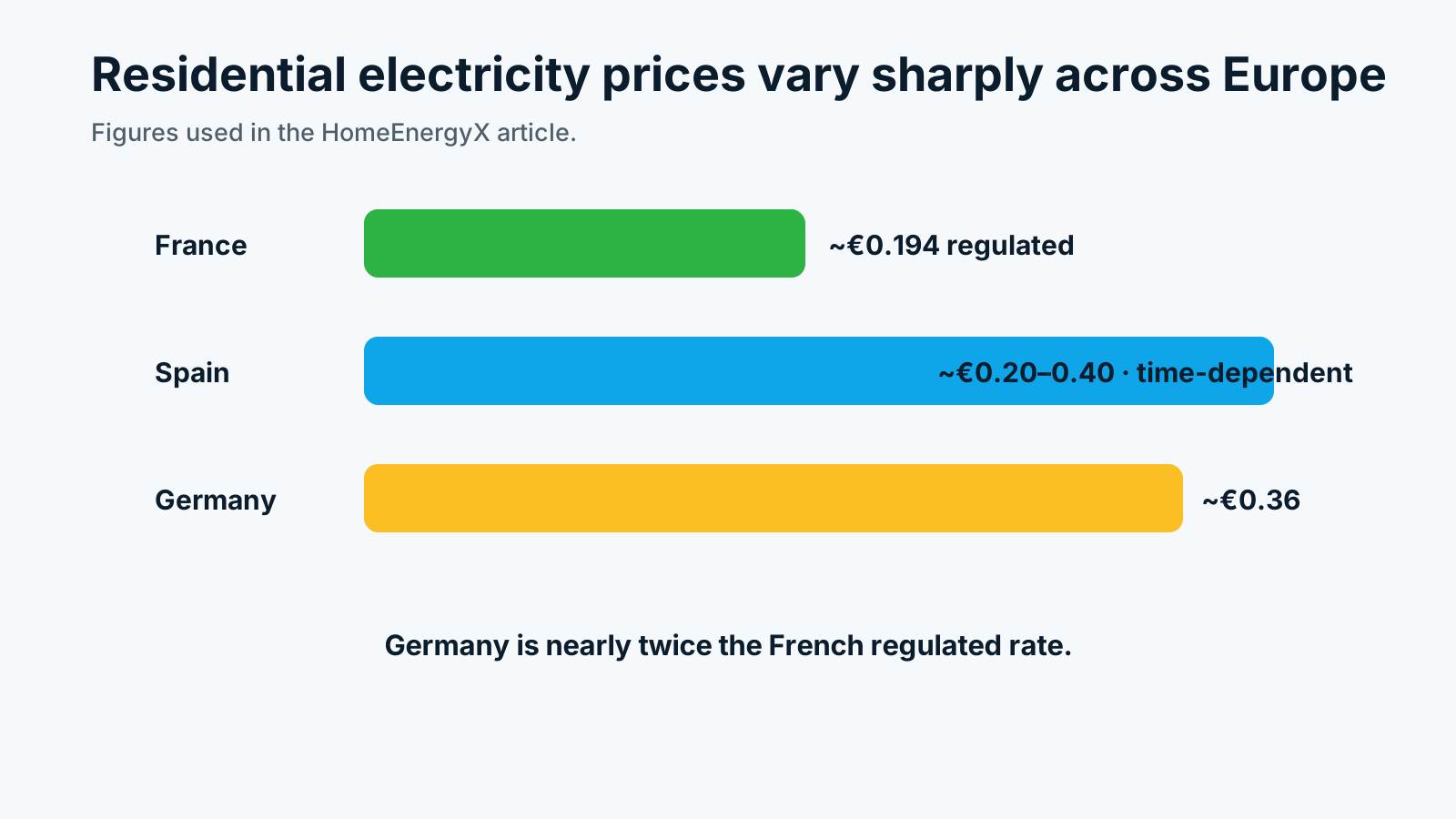
| France | ~€0.194 regulated (EDF Tarif Bleu); alternatives from €0.167 |
| Spain | ~€0.20–0.40, strongly time-dependent |
| Germany | ~€0.36 average, 2026 H1 |
| General home charging range | €0.10 – €0.30 depending on tariff and timing |
The German-to-French gap is the striking one: nearly double for the same energy, between neighbouring countries with interconnected grids.
The explanation is mostly fiscal rather than physical. Taxes, levies and grid fees make up a large share of the German retail price. France’s regulated Tarif Bleu structure, underpinned by a nuclear-heavy generation mix, holds the consumer-facing price down.
For an EV owner this means the same car, driven the same distance, costs roughly twice as much to run in Munich as in Lyon.
The three-phase advantage
This is the structural difference from North America, and it is underappreciated.
Many European homes have three-phase supply as standard. That makes 11 kW charging — and in some cases 22 kW — achievable without any upgrade to the incoming service.
| Europe (three-phase) | United States | |
|---|---|---|
| Typical home AC power | 11 kW, sometimes 22 kW | 7.7–11.5 kW |
| What that requires | existing three-phase supply | 60 A circuit, often a panel upgrade |
| Cost of reaching it | usually nothing extra | $1,500–$3,500 if an upgrade is needed |
An American household wanting 11.5 kW typically needs a 60 A circuit and frequently a service upgrade costing thousands. A German household with three-phase supply often already has what it takes.
The practical consequence: the “how many amps do I need” agonising that dominates US charging discussion is largely absent in Europe, because the answer is usually “you already have enough”.
European home charging, versus North American
Pros
- Three-phase supply makes 11 kW routine without service upgrades
- Type 2 is a single consistent AC standard across the continent
- Some regulated tariffs, like France, are notably cheap
- Off-peak structures are widely available and often generous
Cons
- Retail electricity in several countries is among the most expensive anywhere
- Tax and levy components make prices less responsive to market improvements
- Incentives are fragmenting, with national charger grants narrowing
- Older housing stock, especially apartments, is genuinely hard to serve
What a wallbox costs
| Country | Unit | Installation | Total |
|---|---|---|---|
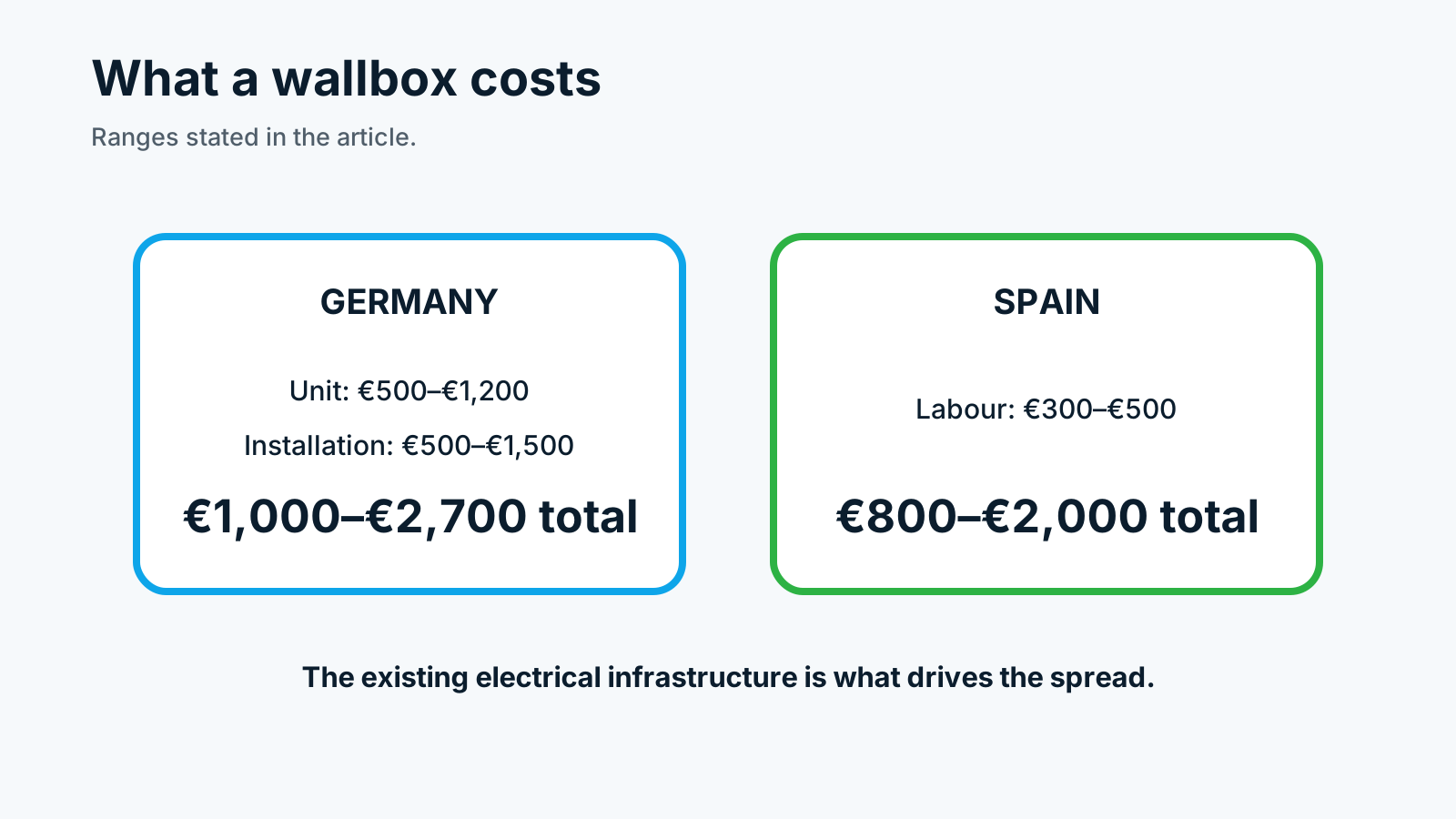
| Germany | €500 – €1,200 | €500 – €1,500 | €1,000 – €2,700 |
| Spain | — | €300 – €500 labour | €800 – €2,000 |
The 11 kW wallbox is the standard choice for German households, and the price spread is driven by the same variable as everywhere: what the existing electrical infrastructure already supports.
These figures sit close to the US range of $1,200 to $3,000. Charging hardware has become a commodity; what you are really paying for is an electrician’s assessment of your building.
Incentives
The direction is toward narrower, more targeted support.
France — the Advenir programme has offered up to €600 toward installing a smart home charger.
Germany — a coalition agreement in late 2025 allocated roughly €3 billion to revive EV support aimed at low- and middle-income households, expected to take the form of purchase grants or social leasing rather than broad charger subsidies.
The pattern matches what happened in the United States, where the federal charger credit expired on 30 June 2026 and support devolved to state and utility programmes. Broad national charger subsidies are being replaced by means-tested, vehicle-focused, or regional schemes.
Check what is currently open in your own country before budgeting around it — these programmes exhaust their funding and close without much notice.
What does not transfer from US guidance
If you are reading American charging content — and most of what ranks in English is American — these are the parts to discard:
- J1772 and NACS. Europe uses Type 2. The entire NACS transition story is a North American matter.
- 120 V Level 1. European supply is 230 V, so the slowest home charging is still around 2.3 kW rather than 1.4 kW — meaningfully faster.
- NEMA 14-50. Not a European connector. The plug-in versus hardwired question exists but the hardware is different.
- The 80% continuous load rule as an NEC concept. European installation standards handle continuous loading differently.
What does transfer: the physics of AC versus DC charging, battery behaviour, charging losses, the value of off-peak tariffs, and the reasoning about how much charging speed you actually need — which is the same question everywhere.
Frequently asked questions
How much does it cost to charge an EV at home in Europe?
Home charging generally runs €0.10 to €0.30 per kWh depending on the country and whether you are on an off-peak rate. Germany sits near €0.36 on average, France's regulated Tarif Bleu near €0.194, and Spain ranges widely with the time of day.
Why is German electricity so expensive?
Taxes, levies and grid fees make up a large share of the German retail price. The cost of generating the energy is a smaller part of the difference than most comparisons suggest.
What does a wallbox cost to install in Europe?
In Germany, roughly €1,000 to €2,700 all in, with the unit itself €500 to €1,200 and installation €500 to €1,500. In Spain, about €800 to €2,000 total, with labour typically €300 to €500.
What connector does Europe use?
Type 2, often called Mennekes, for AC charging. It is not compatible with the J1772 connector used in North America without an adapter, and European supply is 230 V at 50 Hz rather than 120/240 V at 60 Hz.
Why can European homes charge faster than US homes?
Three-phase supply. Many European homes have it as standard, which makes 11 kW achievable without any service upgrade. A US home needs a 60 A circuit and frequently a panel upgrade to reach similar power.