How to Charge an EV Without a Garage
No driveway, no wall, no obvious outlet. Here are the five approaches that actually work for apartments and street parking — and what right-to-charge law does and does not give you.
Most home charging advice assumes a garage, a wall and a panel twenty feet away. For a large share of drivers none of that exists — and the standard answer, “use public charging”, means paying two to three times per mile indefinitely.
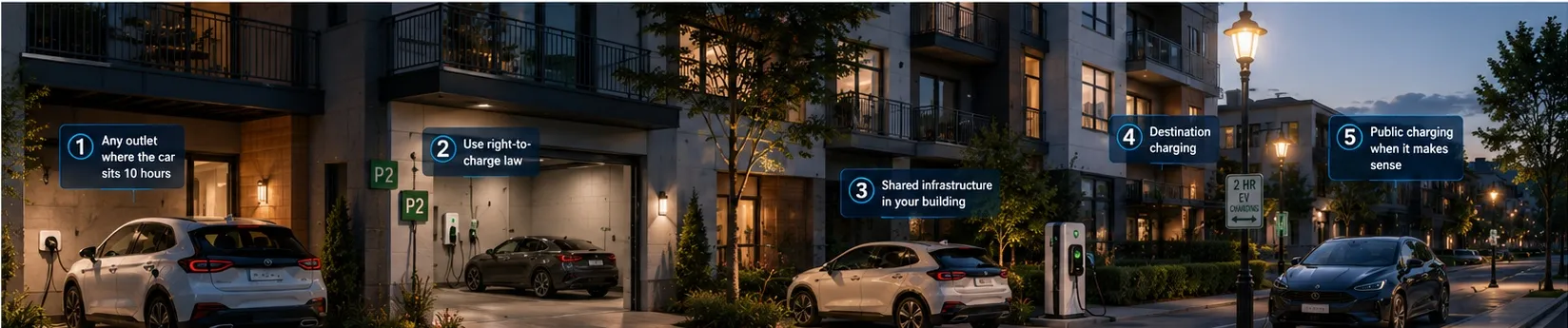
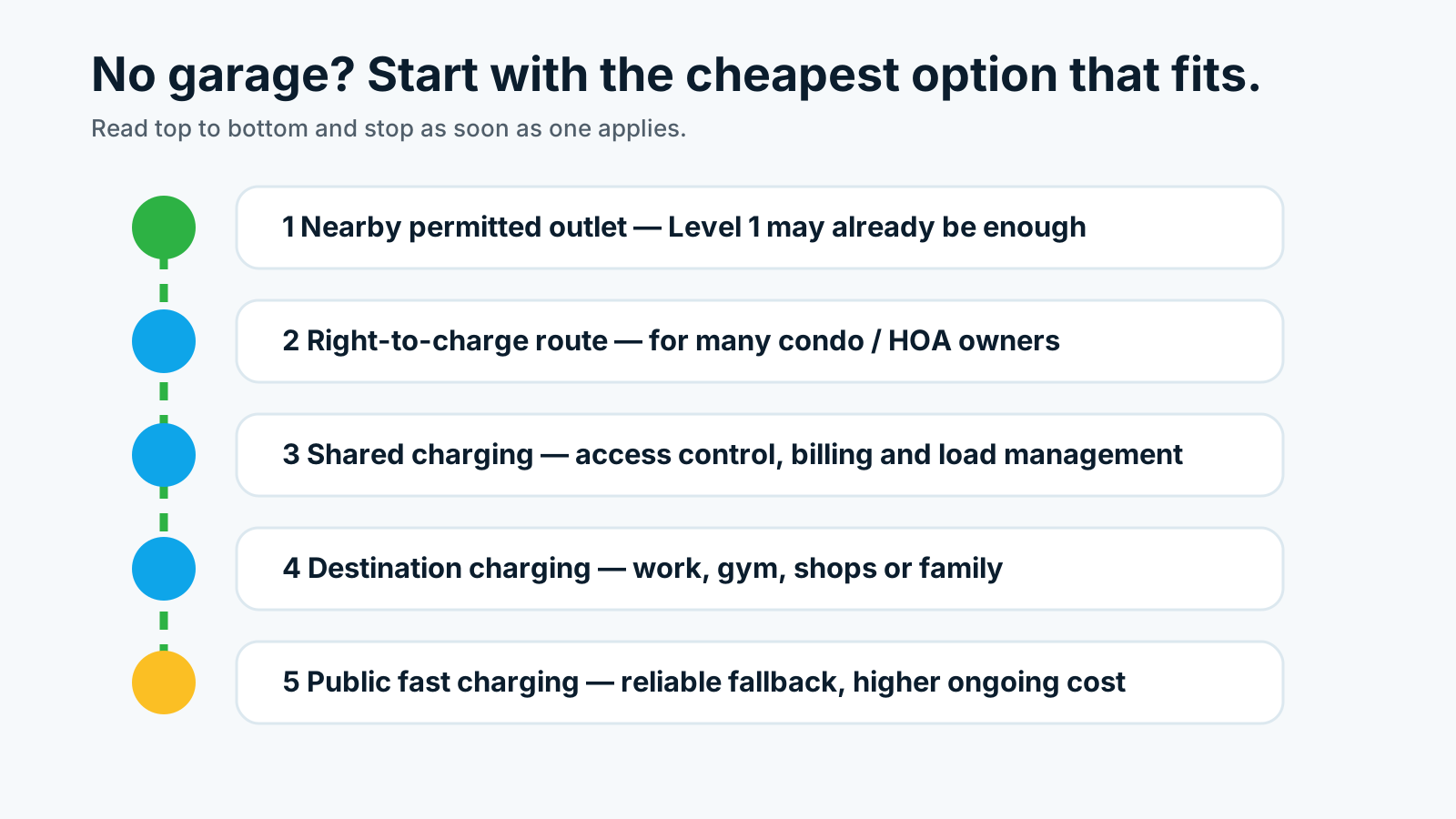
There are five approaches that genuinely work. In rough order of how often they turn out to be the answer.
1. Find any outlet where the car sits ten hours
Start here, because it is free and it works more often than people expect.
Level 1 charging from a standard outlet returns 40 to 55 miles overnight. The average US driver covers about 37 miles a day. If you can reach any outlet where the car parks — an assigned space near a wall, a garage bay you share, a maintenance outlet the building agrees to let you use — the maths frequently works without any installation at all.
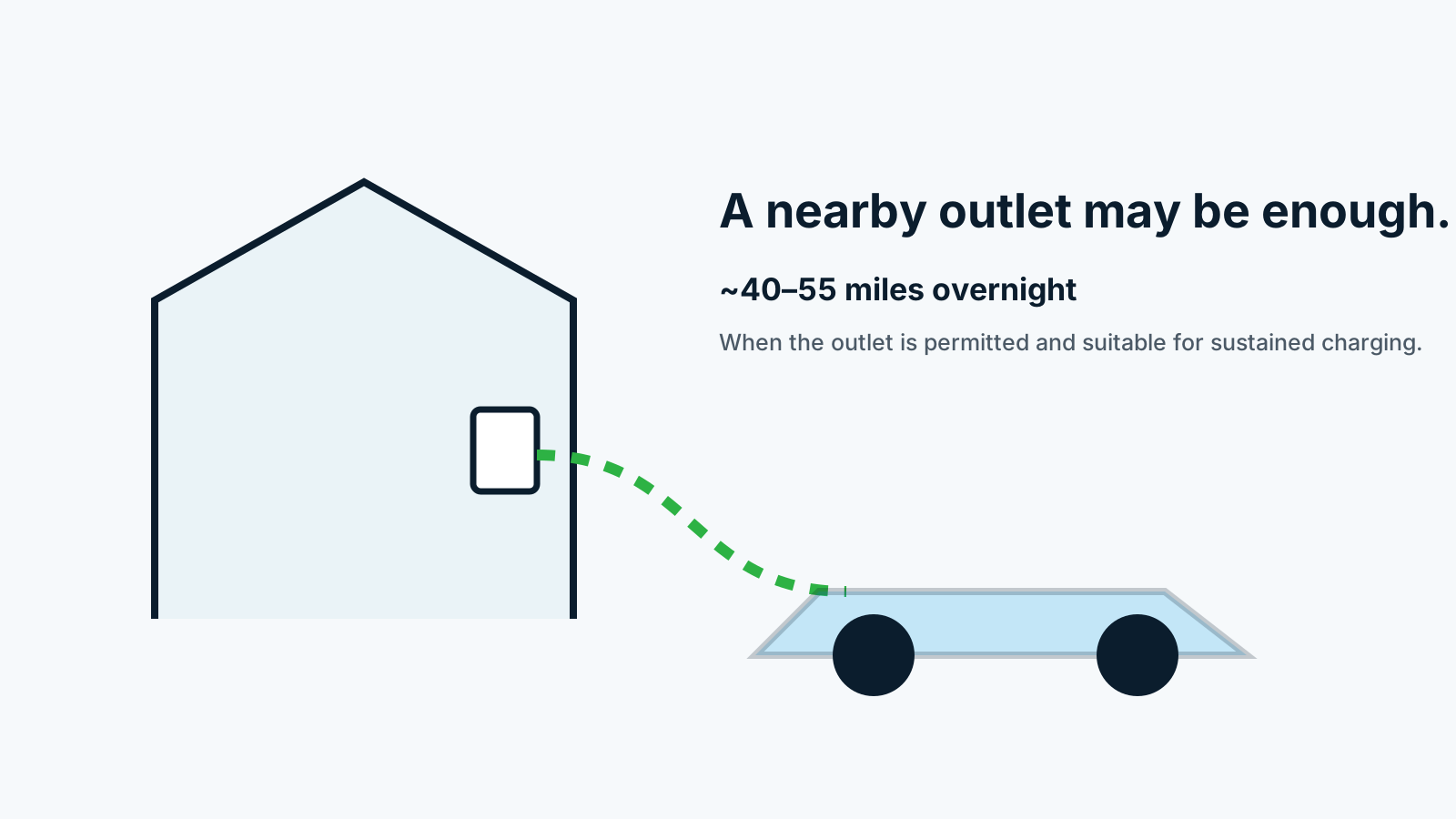
Two conditions:
- Get explicit permission and agree how the electricity is paid for. A metering plug that logs consumption makes this a simple monthly settlement rather than an argument.
- Do not charge through an extension cord. Vehicle manufacturers say so explicitly, and the physics is why: a sustained 12 A draw for eight to ten hours heats a cord designed for intermittent use, along with the connections at both of its ends. If the outlet is out of reach, the answer is a charging cable long enough to reach it, or an outlet fitted nearer the car by an electrician — not a longer cord.
2. Use right-to-charge law
If you own a condo or are in an HOA, this is your strongest lever, and most people do not know it exists.
More than 30 states have enacted right-to-charge legislation as of 2026, including California, Florida, Colorado, Oregon, Washington, Illinois, New York, Texas, Maryland, New Jersey and Connecticut.
The common structure:
- The association cannot unreasonably deny a properly submitted request.
- You pay for installation, electricity, metering and maintenance.
- You carry liability insurance naming the association as additional insured.
- The association must respond within a defined window, often 60 to 90 days — and in some states silence past that deadline counts as approval.
That last provision is the one worth knowing. A board that ignores your request may be approving it by default. Submit in writing, keep the date, and follow the statute’s format precisely.
The detail varies a great deal between states. Read your own statute rather than a national summary — including this one.
Owning in an HOA vs renting
Pros
- Owners in right-to-charge states have a statutory route the board cannot simply refuse
- A deadline that converts silence into approval in several states
- Installation raises the value of your own parking space
Cons
- Renters are usually not covered — protection generally attaches to owners
- You fund the whole cost and carry the insurance
- Approval can still be slowed by reasonable-sounding conditions
- Shared electrical infrastructure may genuinely lack capacity
3. Propose shared infrastructure instead of a personal charger
Often an easier sell to a board than a private installation, and cheaper per space.
The pitch that works is not environmental, it is financial: a small number of shared Level 2 points with access control and per-user billing turns a cost centre into an amenity, and buildings with charging list better. Load management lets several points share one circuit, which is usually the binding constraint in an older building.
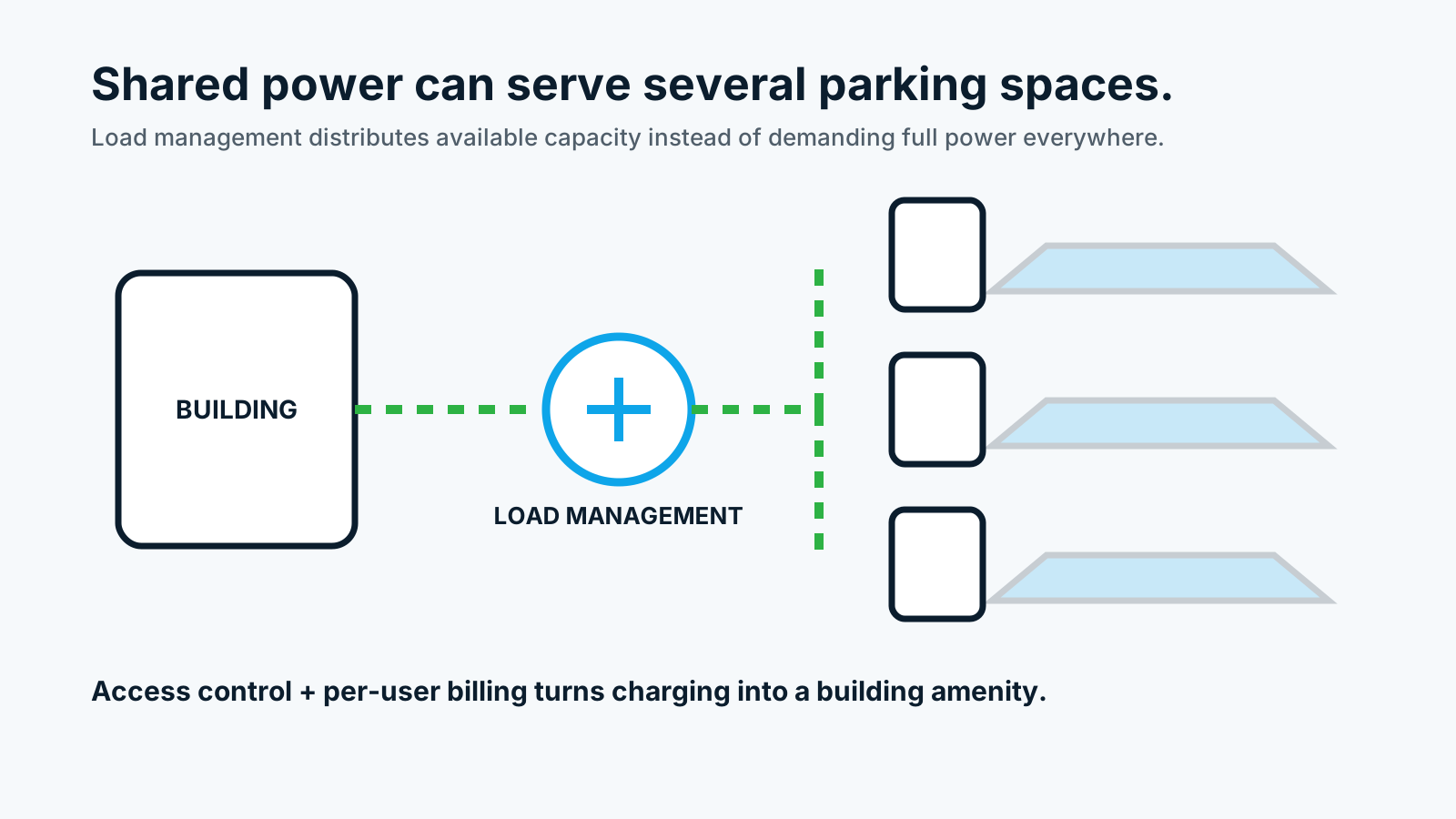
Ask your utility whether they fund multi-unit dwelling projects. Many run programmes specifically for this, precisely because it is the hardest segment.
4. Charge where you already spend time
Workplace charging is the most underrated option in this whole list. The car sits for eight hours, the employer often provides it free or at cost, and it requires nothing from your landlord.
Similarly: a gym, a supermarket you visit weekly, a relative’s house. Two or three sessions a week at destinations you were visiting anyway can cover average mileage entirely.
5. Accept public fast charging — with eyes open
Sometimes there is no route to charging where you park. That is a legitimate outcome, and it should be priced honestly rather than discovered later.
At roughly 40 to 42 cents per kWh against 18.44 at home, relying on public fast charging costs about $900 a year more for 12,000 miles. That is not disqualifying, but it belongs in the purchase decision — we work the comparison through in home vs public fast charging.
What not to do
- Do not run a cord from a communal outlet without agreement. It is theft of electricity, and a cord across a walkway is a liability you personally own.
- Do not use a household extension cord, ever, for charging.
- Do not assume renting gives you the same protection as owning. Right-to-charge statutes generally attach to owners. Some states extend to tenants; most do not.
- Do not lead with the environmental argument to a board. Lead with property value, resident demand and a funding route that is not the association’s budget.
Frequently asked questions
Can my HOA stop me installing an EV charger?
In most US states, not outright. More than 30 states have right-to-charge legislation that prevents an association unreasonably denying a properly submitted request. They can still impose reasonable conditions on permits, insurance and the installation method.
Which states have right-to-charge laws?
Over 30 as of 2026, including California, Florida, Colorado, Oregon, Washington, Illinois, New York, Texas, Maryland, New Jersey, Connecticut and others. Coverage and detail vary considerably, so read your own state's statute rather than a summary.
Who pays for a charger in a condo?
Almost always you. Right-to-charge laws typically require the owner to cover installation, metering and maintenance, and to carry liability insurance naming the association as an additional insured.
Can I charge from a normal outlet in a car park?
Only with the property owner's permission and on a circuit that can take it. Running a cord from a communal outlet without agreement is theft of electricity and usually a trip hazard liability too.
Is Level 1 enough without a garage?
Often, if you can reach any outlet where the car sits for ten hours or more. Level 1 returns 40 to 55 miles overnight, which covers the average 37-mile driving day comfortably.